
“The people, and the people alone, are the motive force in the making of world history.”
— Mao Zedong
- 4.1: What is Socialism?
- 4.2: The Long March to Communism
- 4.3: The Emergence of Dual Power
- 4.4: A Revolutionary Uprising of the People
- 4.5: Building and Defending the Socialist Commune
- 4.6: The Economics of Socialist Transition
- 4.7: Continuous Revolution and the Socialist Transition to Communism
- 4.8: From the Initial Phase of Communism to the World Commune
4.1: What is Socialism?
4.1.1: We define socialism as the historical process of transforming a non-communist society into a communist society.1 The socialist transition from capitalist-imperialism to the initial phase of communism will be a protracted revolutionary struggle, encompassing an entire historical epoch. From politics and culture to the organization of the labor process, all aspects of social life must be progressively transformed in accordance with the logic of communism during this period of socialist transition.
Socialism aims to systematically construct the foundations of communist society. Through the revolutionary process a new socialist person begins to emerge, and new social relations and institutions are developed to ensure the direct satisfaction of human needs through full social provisioning of basic goods and services; the all-round development of human capacities through the socialist transformation of consciousness, culture, and education; and the sustainable stewardship of our planetary ecosystem. The socialist transition to communism will herald the abolition of all exploitative, oppressive, and alienated social relations, and the reconstruction of society on the basis of social ownership and control of the means of production and reproduction; democratic planning and coordination of the labor process; and a system of communal administration based on federative council democracy.
4.1.2: Historical materialism teaches us that such a period of socialist transition cannot be mechanically separated from the initial phase of communist society, nor can this initial phase of communism be neatly separated from a more advanced phase. Instead, each successive phase should be understood as containing aspects of both the old and the new. “During the socialist transition,” Pao-yu Ching writes, “there is no certain predetermined path by which policies and events can be judged to determine whether this path is being followed. Instead, the analysis of socialist transition depends on the general direction of the transition.”2 Thus the socialist transition to communism is to be grasped as a dialectical movement rife with contradiction, in which there is both continuity and change within and between phases. As István Mészáros and Tamás Krausz both envisioned, socialism is a historical process of many “transitions within the transition” and “revolutions within the revolution.”3
Following Marx, we believe that: (a) the core characteristics of a communist society will only emerge in the course of the people’s protracted revolutionary struggle to overthrow the capitalist state, overcome the social relations and institutions of capitalist-imperialism, and build the socialist commune; (b) the initial phase of communist society is, as Marx explained, “economically, morally, and intellectually, still stamped with the birthmarks of the old society from whose womb it emerges,” because contradictions inherited from the old society inevitably persist, new contradictions develop, and revolutionary struggle must continue in order to resolve these contradictions; and (c) a more advanced phase of communist society necessarily develops upon foundations established during the initial phase.4
4.1.3: The central task of the international communist movement is to organize and lead a world socialist revolution to victory against capitalist-imperialism. However, the precise characteristics of this revolutionary process will vary from place to place, in accordance with the particular conditions encountered in each country and region. The unique histories and cultures of diverse peoples; the average levels of literacy and education in various fields of knowledge; the overall level of development of science and technology, the instruments of labor, and the socialization of the labor process; the prevailing social structure and composition of different classes and social groups; the ecological situation; and the correlation of subjective forces prevailing at the national, regional, continental, and international levels are all factors that co-determine the precise starting point and initial trajectory of the socialist revolution within a specific country. Nonetheless, by critically analyzing more than a century of revolutionary struggles and socialist experiments, we can identify general trends and patterns, and synthesize relevant lessons and principles. Only in this way can we discern the probable contours and characteristics of the coming world socialist revolution.
4.1.4: The primary strategic objective of the organized communist movement in a given country is to lead a protracted revolutionary struggle to build the political power of the people, overthrow “their” capitalist state, abolish the social relations and institutions of capitalist-imperialism, and construct a socialist commune in as large a contiguous territory as possible. This socialist commune would replace the capitalist state with a federative council system democratically governed and administered directly by the armed masses of people and their organizations. The charter and constitution of the socialist commune must immediately and unconditionally enshrine equal rights for all social groups oppressed on the basis of race, nationality, ethnicity, caste, religion, gender, sexuality, and disability. The sovereignty and right of self-determination for all nationalities oppressed as internal or external colonies must be immediately granted, up to and including the right to establish autonomous self-governing territories in areas of concentration within the broader territory of the socialist commune, or to separate from the commune altogether and establish independent republics. As the socialist revolution builds momentum for the strategic offensive against the imperialist world-system, the newly-formed socialist communes will be compelled to establish federative unions regionally and internationally so as to foster cooperative relations until the ultimate victory of world communism is secured.
4.1.5: The history of all previous socialist experiments makes clear that,during the socialist transition to communism, characteristics of both communist and non-communist social systems inevitably persist. However, this is not a peaceful and harmonious coexistence. Rather, the emergent social relations and institutions of communism must contend for hegemony with, struggle against, and ultimately overcome the social relations and institutions inherited from capitalist-imperialism. The people’s movement must maintain vigilance and consciously struggle to defeat any and all attempts to usurp the people’s revolutionary political power by either the remnants of the old ruling class, or any new class of bureaucrats generated in the course of the revolutionary process itself (as occurred in the twentieth century in the Soviet Union and China, for example). Socialism, then, is a transitional form of society, synonymous with the historical process of communization, through which the contradictions of capitalist-imperialism are progressively resolved, the enemies of the socialist revolution are roundly defeated, and the material basis for the self-reproduction of a communist social system is gradually established.
4.1.6: The socialist revolution is a people’s revolution in the truest sense, for it aspires to achieve the universal self-emancipation of all exploited classes and oppressed social groups, and to overcome humanity’s alienation from society and nature. In synthesizing the lessons of the Russian Revolution of 1905, for example, Lenin argued that it was “a real people’s revolution” because “the mass of the people, their majority, the very lowest social groups, crushed by oppression and exploitation, rose independently and stamped on the entire course of the revolution the imprint of their own demands, their attempt to build in their own way a new society in place of the old society that was being destroyed.”5 We never tire of emphasizing this fact: the masses make history.
Within the people’s movement, the proletariat establishes its class hegemony and constitutes itself as the leading class of a new historical bloc. By virtue of their social position within the labor process, proletarians belong to the only class with an objective historical interest in total liberation: the working class cannot liberate itself without liberating humanity as a whole from all forms of exploitation, oppression, and alienation. The socialist revolution is thus a revolution of the immense majority, in the interest of the immense majority. The ultimate aim of this revolution is nothing less than the liberation of humanity and our planetary ecosystem from the imperialist world-system and the social domination of capital. It is a social revolution that is at once proletarian, feminist, decolonial, democratic, and ecological, i.e. a real people’s revolution.
4.1.7: As the social contradictions of capitalist-imperialism will not be spontaneously overcome, the proletarian class struggle and popular feminist, decolonial, democratic, and ecological struggles will inevitably continue during the period of socialist transition. Developing from the system of counterpower constructed in the preceding phases of protracted revolutionary struggle against the capitalist state, a system of revolutionary people’s power will be necessary throughout the whole period of social reconstruction to prevent the restoration of capitalist-imperialism, defend the socialist commune from the imperialist counterrevolution and fascist reaction, and lead the process of building the commune through the construction of new social relations and institutions and the transformation of human consciousness. Based on popular democratic assemblies and councils, this system of revolutionary people’s power constitutes the political form through which the liberation of humanity can be progressively secured during the socialist transition to communism.
4.1.8: According to historical materialism, all societies in which the population is divided into antagonistic classes and social groups are necessarily social dictatorships. The historical form through which this social dictatorship is exercised is known as the state, and the specific classes and social groups in command of the state will vary in accordance with the historical development of society and the prevailing organization of the labor process. Thus the label of “dictatorship” is equally valid for a bourgeois democratic republic as it is for a feudal monarchy, tributary empire, or fascist regime. The important question is not if this or that form of class society is a social dictatorship, but of the social forces at the helm and the politics in command.
What happens, however, when the masses of people succeed in wresting political power from the bourgeoisie in a popular revolutionary uprising and establishing a socialist commune? Will the old ruling class simply throw in the towel and accept the new arrangement peacefully and quietly? We think not! As Joseph Weydemeyer explained, “it is an old principle of experience that no social class, even if the ground under its feet is already giving way, abandons its hope that it will be restored to its former position as long as its demise is not an accomplished fact.”6 It is therefore necessary for the popular revolutionary movement to organize the containment and suppression of the overthrown bourgeoisie, to thwart the corrosive influence of its culture and ideology, and to establish the hegemony of scientific socialism in all spheres of social life. Historically, revolutionary Marxists have referred to this arrangement as the dictatorship of the proletariat, defined by Marx as the exercise of proletarian political power by the masses during the revolutionary transition to communism.7
4.1.9: For socialist democracy to flourish, the people must exercise their social dictatorship over and against the resistance of their former exploiters and oppressors. “A revolution,” Engels tells us, “is the act whereby one part of the population imposes its will upon the other part by means of rifles, bayonets, and cannon… Would the Paris Commune have lasted a single day if it had not made use of this authority of the armed people against the bourgeoisie? Should we not, on the contrary, reproach it for not having used it freely enough?”8 In no uncertain terms, Rosa Luxemburg also emphasized that, with the successful conquest of political power, the masses of people “must at once undertake socialist measures in the most energetic, unyielding, and unhesitant fashion, in other words, exercise a dictatorship.”9
Such a political orientation must not, however, be confused with partydictatorship, and still less with personal dictatorship, as so often occurred last century. The socialist revolution of the twenty-first century must establish the dictatorship of the proletariat based on the most active participation of the exploited and oppressed masses in the democratic governance and administration of society. It is a matter of developing the revolutionary consciousness and capacities for self-organization and self-activity among the masses. It is a matter of fostering the people’s protagonism in the revolutionary process in the face of the counterrevolutionary siege and sabotage of the imperialist bourgeoisie and the lingering persistence of old ideas and social relations. As Luxemburg provocatively argued in her constructive criticism of the Bolsheviks, the question of proletarian dictatorship is inseparable from the question of proletarian democracy:
Yes, dictatorship! But this dictatorship consists in the manner of applying democracy, not in its elimination, but in energetic, resolute attacks upon the well-entrenched rights and economic relationships of bourgeois society, without which a socialist transformation cannot be accomplished. But this dictatorship must be the work of the class and not of a little leading minority in the name of the class—that is, it must proceed step by step out of the active participation of the masses; it must be under their direct influence, subjected to the control of complete public activity; it must arise out of the growing political training of the mass of the people.10
It is not a question of choosing democracy or dictatorship, as paradoxical as this may sound to some ears. It is instead a question of combining “democracy for the people and dictatorship for the reactionaries,” as Mao put it. In his reformulation of the concept, this constitutes the people’s democratic dictatorship, under the class leadership of the proletariat, and based on the alliance of the working class with all oppressed social groups.11 This people’s democratic dictatorship is itself an expression of the new contradictions which arise once the state power of the imperialist bourgeoisie has been shattered by a popular revolutionary uprising and the socialist commune has been established but not yet consolidated.
4.1.10: For Lenin, proletarian dictatorship is characterized by “the continuation of the class struggle,” marked by “the destruction of bourgeois democracy and the creation of proletarian democracy.”12 If bourgeois democracy has historically limited itself to establishing “democracy for the rich” (a truth that becomes clearer by the day as the concentration and centralization of imperialist capital accelerates, and an increasingly authoritarian and bureaucratic form of “democracy” takes shape), then the people’s democratic dictatorship under proletarian leadership aims to “establish democracy for the poor,” for the masses, for the people.13
In the context of a class society, democracy and dictatorship are relative concepts united in dialectical tension. As a unity of opposing forces, it is unavoidable for the revolutionary process of socialist transition to assume aspects of both democracy [of, by, and for the people] and dictatorship [over and against the bourgeoisie and fascist reaction]. The contradiction between these two opposing aspects can only be resolved with the successful abolition of the old society and the resolution of its major contradictions, the reconstruction of society on new foundations, and a continuation of the revolutionary process to transform consciousness and culture. Only then will the “government of persons” give way to “the administration of things and the direction of the processes of production,” as Engels put it.14
4.1.11: The socialist commune’s system of revolutionary people’s power can best be described as a counterstate, semi-state, or commune state, that is, “a state of the Paris Commune type,” for it is not a state in the traditional sense of the term.15 Rather, the socialist commune is based on the people’s democratic dictatorship, understood as the political power of the armed masses organized in a federative council system, and wielded in the service of laying the foundations of communist society. It is “the political form at last discovered under which to work out the economic emancipation of labor,” as Marx and Engels suggested.16 The aim of communists is not to create another alienated and parasitic state power. Instead, the socialist transition to communism aims for the reabsorption of state power as an organic force by society itself. The commune as counterstate gradually dissolves once the exercise of revolutionary political power over and against the former exploiters and oppressors is no longer necessary, because classes have ceased to exist and a more advanced form of stateless communism has emerged on a world scale.
Some comrades may interrupt us here and say, “What’s with all this talk of a ‘commune state’ and ‘people’s democratic dictatorship’… are these not wildly contradictory concepts?!” To this we reply with the words of comrade Anacaona Marín, a revolutionary cadre from El Panal Commune and Alexis Vive Patriotic Force in Venezuela: “We welcome contradictions. If we didn’t have them, it would mean that we wouldn’t have a project.” As we liberate ourselves through revolutionary struggle, “it opens a space for the new to bloom, and that flower springs forth from the creative tensions.”17
4.1.12: For the Communard Union of Venezuela, “the commune must be the epicenter of popular and sovereign power.”18 It must be the seedbed from which a hundred flowers can bloom. Unlike the capitalist state which precedes it, however, the commune state must ultimately lead to the abolition of the state itself. This “communal road to socialism” (or “socialist road to the commune,” as we’d phrase it) calls for the development of grassroots popular initiatives from below to advance the revolutionary process in all spheres of social life. To guide their work, the Communard Union has identified five strategic areas of focus for the construction of the socialist commune:
- Polity: Build a participatory and protagonistic democracy that unites the organs of revolutionary counterpower (i.e. popular assemblies, councils, committees of struggle, the organizations of the united front, etc.) with the constitution, laws, and institutions of popular revolutionary government.
- Territory: On the basis of communal federation, create a new geography that corresponds with the real needs and everyday life of the people, transcending the territorial form of the nation-state inherited from capitalist-imperialism with its the division between urban and rural, town and country.19
This strategic framework has guided the praxis of revolutionary cadres engaged in building communes at the local level as “socialist cells,” with the communal council conceived as the nucleus of the cell. Cells, however, do not exist in isolation. As Hugo Chávez explained: “The cells have to branch out and link. They have to form a system, articulate, and give shape to a body.”20 That body, of course, is the commune state, based on a countrywide union of communal councils.
“You have to break the old paradigms,” Chávez instructed. He called upon revolutionaries to break with the territorial divisions imposed on the world by imperialist capital through the nation-state system, and to replace it with a “socialist geography” based on the commune. “Dead geography is what divides us. The new geography has to unite us.”21 Robert Longa, another cadre from El Panal Commune and Alexis Vive Patriotic Force, argues that we must “view the communal state as a transitional phase and, therefore, not as an end unto itself.” The ultimate goal of the socialist revolution must be nothing less than “the abolition of the state” and the construction of “a classless society, where the new human being leads both production and politics.”22 The commune state is merely the cell of a new international system, prefiguring and anticipating the construction of the world commune of communes.
Facing a prolonged crisis, the most advanced contingents of the popular revolutionary forces in Venezuela have called upon the people to break decisively with the bourgeois democratic state, and to take the socialist road to the commune. The choice is clear: “Commune or nothing,” as Hugo Chávez said.23 Looking at the contradictions and crises of capitalist-imperialism on a world scale, it is obvious that this is, in fact, the only way forward for humanity as a whole. While it is undoubtedly true that the revolutionary process will vary greatly from country to country, we have much to learn from Venezuelan comrades.
4.1.13: The socialist revolution aims to resolve the social contradictions inherited from the historical development of capitalist-imperialism, such as the contradiction between a socialized labor process and the private appropriation of the social product, or between manual and intellectual labor. However, as these contradictions are resolved through the revolutionary process, new contradictions will inevitably emerge as the socialist transition to communism progresses. For example, the contradiction between centralization and decentralization in the economic planning process, or between the local and global. Communists must be prepared to identify these new contradictions as they emerge, and mobilize the people to resolve them through their autonomous mass organizations.
Interlude: An American Commune in the Reconstruction Era?
In what surely remains a surprising observation, W.E.B. Du Bois saw in the historical experience of the American Civil War and Reconstruction “one of the most extraordinary experiments of Marxism that the world, before the Russian Revolution, had seen.” Following the defeat of the Confederacy in the U.S. South, Du Bois argued that “a dictatorship of labor,” backed by the military power of the Union Army, was briefly established.24 In order to secure the revolutionary transformation of society, this “abolition-democracy,” as Du Bois called it, required a degree of centralized political power defended by force of arms:
It was a dictatorship backed by the military arm of the United States by which the governments of the Southern states were to be coerced into accepting a new form of administration, in which the freedmen and the poor whites were to hold the overwhelming balance of political power. As soon as political power was successfully delivered into the hands of these elements, the Federal government was to withdraw and full democracy ensue.25
The revolutionary process, however, is never so linear. As Du Bois recognized, a proletarian dictatorship must last long enough to empower the exploited and oppressed masses to gain the necessary consciousness and capacities to democratically govern society through education and experience, and to decisively break the stubborn resistance of capital, forever eager to stage a comeback. “Unfortunately,” Du Bois explains, “the power set to begin this dictatorship was the military arm of a government which more and more was falling into the hands of organized wealth, and of wealth organized on a scale never before seen in modern civilization.”26
The contradiction between labor and capital, with the former represented by the “abolition-democracy” of the Reconstruction governments and the latter by the Northern industrialists was, for the time being, relegated to secondary status so long as the agrarian slavocracy of the South remained the main enemy of the Union for labor and industrial capital alike. “By singular coincidence and for a moment, for the few years of an eternal second in a cycle of a thousand years,” Du Bois wrote, “the orbits of two widely and utterly dissimilar economic systems coincided and the result was a revolution so vast and portentous that few minds ever fully conceived it.”27
As dialectical materialism teaches us, however, “one divides into two,” and we can thus speak of not one, but two Reconstructions. It was in the progressive aspect of this contradiction that, according to Noel Ignatiev, Du Bois was able to envision the possibility of a continuous revolution, “a revolution without fixed limits, in which one phase could pass over imperceptibly to the next.”28 It was in the midst of Civil War and Reconstruction that the contradiction between the two possible futures for humanity was revealed: the choice between the democratic dictatorship of labor, or the despotic dictatorship of capital.
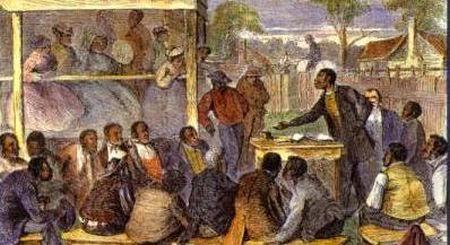
In the historical process of civil war and social reconstruction, the Union brought together an alliance of two social forces, each representing two distinct roads to opposing social systems. On the one hand, “a democracy which should by universal suffrage establish a dictatorship of the proletariat ending in industrial democracy,” and on the other hand, “a system by which a little knot of masterful men would so organize capitalism as to bring under their control the natural resources, wealth, and industry of a vast and rich country and through that, of the world.”29 The consequence of labor failing to establish and maintain its hegemony within this unstable alliance was, of course, nothing less than a thoroughgoing counterrevolution. The progress made during Reconstruction was reversed, and white supremacy restored. The effects of this tragic defeat continue to reverberate in all aspects of American society today, and the socialist revolution is tasked with completing the unfinished revolution of Reconstruction.
For those who think Du Bois may have gone too far in describing Reconstruction as a proletarian dictatorship, Noel Ignatiev offers an important corrective. “The most drastic economic reform introduced by the [Paris] Commune [of 1871],” he tells us, “was the abolition of night work for bakers.” He continues: “Compared to the moderation of the [Paris] Commune, the accomplishments of Reconstruction in South Carolina seem like the wildest radicalism.”30 These accomplishments include the abolition of property requirements for public office, shifting legislative representation from property ownership to population, abolishing the imprisonment of debtors, establishing a public education system, expanding rights for women, creating institutions for people with disabilities, and reforming the tax code. “A program of this sort, carried out against a background of mass movement, may not yet be communism,” Noel Ignatiev argues, “but it is no longer capitalism.”31 Reconstruction was a historical process of transition during which revolution and counterrevolution battled for hegemony. In what remains an instructive historical perspective, Ignatiev chides those American socialists who “were able to look across the ocean to the Paris Commune, but could not cast their eyes southward to the South Carolina Commune.”32
Writing in the years after World War I, in the midst of the Great Depression, and on the eve of World War II, Du Bois saw a world torn asunder by irreconcilable contradictions between exploiters and exploited, oppressors and oppressed, capital and labor. From this vantage point, Du Bois saw clearly that “the rebuilding, whether it comes now or a century later, will and must go back to the basic principles of Reconstruction in the United States during 1867–1876,” and win liberation for all exploited and oppressed peoples “under a dictatorship of the proletariat.”33
4.2: The Long March to Communism
4.2.1: The socialist transition to communism presupposes the seizure of political power by the people. The socialist revolution must “raise the proletariat to the position of the ruling class” and “win the battle of democracy,” empowering the exploited and oppressed masses to liberate themselves and build the socialist commune.34 However, the capitalist state cannot be transformed into a commune state through a series of reforms, no matter how progressive. While the election of a pro-socialist government may precipitate a revolutionary crisis that can be seized by revolutionary forces—and such a government may even support the construction of the commune—no bourgeois government can substitute itself for the communal self-government of the masses. Ultimately, the capitalist state must be overthrown by a popular revolutionary uprising that smashes its military and bureaucratic machinery, replacing it with the direct democracy of the armed people organized in popular assemblies, councils, and committees of struggle. On the ashes of the capitalist state, the socialist revolution will establish the commune state as the first step in the process of building an international union of socialist communes, on the road to the classless and stateless society of communism.
4.2.2: The internal contradictions of capitalist-imperialism generate the objective conditions from which the socialist revolution develops. In making a revolution, however, it is the subjective factor which is always decisive: the victory of a popular revolutionary uprising hinges upon the successful construction and consolidation of a revolutionary united front of mass organizations, defense organizations, and party organizations, embedded in the fabric of everyday life and capable of building a territorial system of counterpower. Through the social insertion and mass work of revolutionary cadres in the organs of counterpower created by the masses—popular assemblies, councils, and committees of struggle—the organized communist movement gains the conscious support of the masses for a revolutionary program, and wins their unambiguous consent to lead the united front in the struggle to overthrow the capitalist state, seize countrywide political power, and establish the socialist commune.
4.2.3: While openly acknowledging the irredeemably exploitative and oppressive character of the imperialist world-system and the historical necessity of the masses to conquer political power by means of a popular revolutionary uprising, alongside the future emergence of revolutionary situations from the sharpening of social contradictions and the ripening and convergence of multiple systemic crises, communists must never disregard the strategic importance of waging mass campaigns for immediate demands (i.e. reforms). To the contrary, it is precisely in the course of such campaigns that the revolutionary consciousness of the people is developed, their fighting spirit elevated, and their capacities for self-organization and self-activity cultivated and honed. In this respect, the Spanish word “reivindicación,” which in Latin America refers to struggles to reclaim or defend the rights of the people, more accurately captures the essence of our approach than does the word “reform.” The word “reappropriation” is probably the closest equivalent found in English.
Prior to the development of a situation of dual power, the organized communist movement cannot stand on the sidelines of struggles to win material improvements in the everyday working and living conditions of the masses, nor can the members of a communist party separate themselves from the mass organizations of the exploited and oppressed. To the contrary, communists must be the most active and ardent participants in popular struggles to resist displacement and dispossession, improve the wages and benefits of workers, defend and expand the public sector, reappropriate and redistribute the social product, defend and expand the democratic rights of the people, and mitigate the planetary ecological crisis.
The Third Congress of the Communist International clearly established the relationship between partial struggles for immediate demands, and the ultimate aims and program of the socialist revolution. While recognizing that “no enduring improvement in the conditions of the masses is possible in a capitalist framework,” it was nonetheless crucial for communist parties to participate in the mass organizations of the exploited classes and oppressed social groups to win material improvements in everyday life (i.e. lower rent, higher wages, expansion of public services, etc.).35 It is by leading struggles “for all the proletariat’s vital necessities,” regardless of their compatibility with the accumulation of capital, that a communist party “demonstrates how the struggle should be carried out.”36
In opposition to the reformists and revisionists who can’t even fight for a loaf of bread, “the task… is to take all the masses’ interests as the starting point for revolutionary struggles that only in their unity form the mighty river of revolution.”37 In the course of waging partial struggles for immediate demands, contradictions sharpen and the line between friend and enemy is clearly demarcated, as the iron fist of the capitalist state comes to the aid of the employers and reactionaries. To the extent that partial struggles of a specific sector of society are broadened into a general struggle of the masses against capitalist-imperialism, communists must escalate and generalize their slogans, heighten the combativity of the masses, strengthen the system of counterpower, and ultimately lead the people’s struggle towards a singular demand: the conquest of political power and establishment of the socialist commune.
4.2.4: The development of the revolutionary consciousness and capacities of the people will not occur spontaneously as a result of mass campaigns for immediate demands. In the absence of a fighting communist party, for example, the demands of trade unions will tend toward economism. Such an approach rejects the necessity of waging a protracted revolutionary struggle for the socialist commune, resulting in acclimation to the rhythms of bourgeois society and acceptance of the unfettered social domination of the capitalist state and imperialist world-system. As Lenin explained, in the course of their participation in struggles over wages, benefits, the length and intensity of the working day, and so on, workers tend to develop “trade union consciousness” organically, “i.e., the conviction that it is necessary to combine in unions, fight the employers, and strive to compel the government to pass necessary labor legislation, etc.”38 While a necessary step beyond the Stockholm syndrome promoted by reformists and revisionists, communists must organize for the self-emancipation of labor from capital by overthrowing the capitalist state and building the socialist commune, not limiting the struggle to minor improvements in the terms and conditions of our exploitation and oppression.
How then can this economic consciousness develop into political consciousness—i.e. the conviction that freedom for the exploited and oppressed masses can only be achieved by overthrowing the imperialist bourgeoisie, smashing the capitalist state, conquering countrywide political power, and building and defending an international union of socialist communes on the road to communism? Such a perspective can only emerge from the purposeful political intervention of revolutionary communists who—organized as a fighting party within the people’s movement—systematically wage the battle of ideas to win the masses to the theoretical, ideological, and political framework of revolutionary Marxism, and formulate a socialist program on this basis.
4.2.5: Analyzing the defeat of the Italian communist movement at the hands of fascism in the aftermath of the Biennio Rosso, Antonio Gramsci realized that, in the context of contemporary capitalist-imperialism and the modern capitalist state, and especially within the imperial core countries, the revolutionary struggle would be protracted in nature. This revolutionary process would be akin to trench warfare, ultimately constituting a form of “total war.” This would demand an unprecedented transformation of popular consciousness and culture, immense commitment and sacrifice on the part of the people, and encompass all aspects of social life. Gramsci termed this type of struggle a war of position.39
For Gramsci, the conquest of political power by the people begins in the trenches of civil society. The ultimate success of a popular revolutionary uprising and establishment of a commune state presupposes the construction of a new “historical bloc.” Adapting this concept to our conjuncture, we conceive of the historical bloc as the fusion of the working class with the liberation struggles of all oppressed social groups on the basis of scientific socialism and in the organizational form of a revolutionary united front. In turn, the revolutionary proletariat leads all progressive non-proletarian classes; the liberation movements of the oppressed social groups lead all progressive allies drawn from the masses. Within a given country, a historical bloc articulates what Gramsci described as a “national-popular collective will,” whereby a common revolutionary vision unites the masses of people in their millions around a common political project, rooted in the unique historical characteristics and contradictions of the country.
“To be sure,” Gramsci explained, “the line of development is towards internationalism, but the point of departure is ‘national’—and it is from this point of departure that one must begin.”40 In other words, the global revolutionary struggle must proceed from local realities, which can only be discerned if communists engage in “accurate reconnaissance,” i.e. utilize the tools of social investigation and compositional analysis to formulate political programs, strategies, and operational plans.41 The organized communist movement can achieve its aims only by leading mass struggles that address the particular needs, grievances, and interests of all exploited classes and oppressed social groups, while building and maintaining their strategic alliance in the united front. In the course of their social insertion and mass work in the people’s struggle, communists raise the political consciousness of the masses and develop their capacities for self-organization and self-activity in ways that are attuned to the cultural realities of the country. As this work progresses, a common identity as a revolutionary people begins to cohere within the historical bloc, and a new society, new country, and new humanity begin to take shape.
4.2.6: To wage a war of position, the organized communist movement must systematically construct a revolutionary counterhegemony among the masses to contend with the ideological and cultural hegemony of the imperialist bourgeoisie in all areas of social life. “To overthrow a political power,” Mao teaches us, it is necessary “to create public opinion, to do work in the ideological sphere.”42 This requires the articulation of a new ideology and development of a new culture prior to the people’s seizure of political power and establishment of the socialist commune.
It is only through the construction of a popular revolutionary counterhegemony that a new “common sense” begins to emerge, with scientific socialism as its basis. Through the new culture, the exploited and oppressed masses are gradually prepared to lead the revolutionary process through its successive phases, from the conquest of political power and founding of the socialist commune, to the socialist transition to communism. This is achieved by “conquering combat positions” in the trenches of civil society, to use Althusser’s expression, through mass campaigns waged inside established institutions, alongside the construction of alternative institutions, in the fields of ideology and culture—encompassing music, art, literature, media, education, sports, etc.43
4.2.7: Only by waging a war of position on the cultural and ideological terrain of civil society will the popular revolutionary movement be capable of successfully initiating and sustaining a strategic counteroffensive against the capitalist state and the imperialist world-system. Gramsci termed this insurrectionary pivot a war of movement, akin to a frontal assault in warfare. While it should be obvious that there will be localized “wars of movement” within a historical period broadly defined by “a war of position” (and the two forms of war are, in fact, dialectically linked), it should be equally obvious to all who dare to struggle for communism that we have a long march ahead of us.
The repressive capacities of the modern capitalist state are immense, and recent advancements in surveillance technologies, artificial intelligence, and automated weapons systems pose new challenges to revolutionary movements. Yet this point must not be exaggerated. All imperialists and reactionaries are paper tigers, their “order” is built on sand, the power of the people is greater than the murderous machinery of the capitalist state, and the workers of the world are not in the least afraid of ruins for we built this world, we can build it again, and we carry a new world in our hearts. From Russia to Spain, China to Cuba, Vietnam to Palestine, the pages of world history are filled with heroic episodes demonstrating this truth.
However, the modern capitalist state is far more than an instrument for the exercise of naked violence by the bourgeoisie against the exploited and oppressed masses. Rather, the integral state of capitalist-imperialism combines the most brutal coercive violence with the systematic production of the imperialist bourgeoisie’s ideological and cultural hegemony. Millions upon millions of people worldwide consent to and actively participate in the imperialist world-system, however passively. To lay the groundwork for the conquest of political power by the people’s movement and subsequent establishment of a socialist commune, the hegemony of the capitalist state must be systematically eroded and a new revolutionary counterhegemony constructed. In the course of the protracted revolutionary struggle, the organized communist movement must build the class hegemony of the proletariat—i.e. its social and political leadership vis-à-vis the non-proletarian middle classes—as well as the theoretical, ideological, and political hegemony of scientific socialism within the people’s movement, ultimately articulating a historical bloc in which the masses come to see themselves as a new people—a revolutionary people—united around a common vision and program of revolutionary social change.
The war of position cannot be won by waging isolated local struggles unconnected to a broader strategic vision. At best, such struggles will have tactical significance for the revolutionary process. To attain strategic significance, as the strategy of people’s war requires some form of centralized political leadership to coordinate guerrilla offensives on multiple military fronts simultaneously, so too do local political fronts of struggle require a degree of centralized political organization to coordinate actions at the national and international levels in accordance with a general strategy and program.44
4.2.8: In many countries—and especially in the imperial core—a system of counterpower will initially emerge not as a series of contiguous liberated territories (like Yan’an in China), but as a diffuse patchwork of urban nodes. We envision the formation of revolutionary base areas in neighborhoods, industrial belts, and strategic hubs connected by revolutionary media and communications infrastructure. We do not anticipate the liberation and defense of large territories until a later phase in the revolutionary process. Whenever rudimentary organs of counterpower emerge in isolation—a workers’ council in one factory, a people’s assembly in one neighborhood—it is crucial to avoid decisive engagements with state forces in defense of that territory absent a countrywide revolutionary crisis and favorable correlation of forces. Isolated organs of counterpower will be targeted for containment and suppression campaigns by the state. To advance to the next phase of struggle, a system of counterpower must first be organized and consolidated on a territorial scale sufficient that it could, given the right conditions, sustain a popular revolutionary uprising and serve as a foundation and scaffolding for a socialist commune.
Nonetheless, circumstances are often beyond our control, and cruel acts of injustice compel the masses to rebel. In such situations, the correct policy of a communist party to follow is to support the righteous struggle of the people and not stand on the sidelines. A fighting communist party must be prepared to swim in the sea of spontaneous mass rebellion, providing support wherever possible—be it strategic, tactical, programmatic, organizational, or logistical—and offering strategic guidance and political leadership wherever appropriate. By agitating for the formation of communal assemblies and councils in workplaces and neighborhoods, and by taking positions on the frontlines of the people’s struggle, we can influence the development of the revolutionary consciousness, self-organization, and self-activity of the masses. From the frontlines of struggle, a fighting communist party—no matter how small—can win the trust of the people, unite with their mass vanguards on the basis of a communist platform and program, and emerge from the heat of battle stronger, armed with a larger sense of purpose, possibility, and direction.
4.2.9: A number of recent studies indicate that the likelihood of success for a popular revolutionary uprising is closely correlated to force ratios—the ratio of the overall size of the state’s repressive forces relative to the popular revolutionary forces.45 While domestic police forces in the United States have militarized and grown from a force of ~300,000 in 1968 to more than 800,000 today (a nearly three-fold increase), the U.S. military has, in fact, contracted from 3.5 million personnel in the era of the imperialist wars in Korea and Vietnam to around 1.4 million today, placing the total number of repressive forces at the immediate disposal of U.S. imperialism at a level significantly lower than in previous decades. It should be obvious that this reduction in force has been accompanied by the further professionalization of military forces, new advancements in military technologies, and the proliferation of private military and security companies.
Yet recent historical research reveals that reductions in force size ratios have—even in the contemporary context—created certain strategic advantages for revolutionary forces operating in urban environments. “Although advanced surveillance technology has certainly helped [offset the effects of force reductions],” Anthony King writes, “urban operations still require a substantial and permanent physical presence on the streets to maintain public order, to reassure the civilian population, to gather intelligence, and to restrict insurgent freedom of movement.”46
4.2.10: If Anthony King’s assessment is correct, then our historical conjuncture may present certain advantages for popular revolutionary movements in complex urban and periurban environments. Indeed, the massive popular support for and rapid territorialization of the George Floyd Uprising across multiple U.S. cities in 2020 reveals that the primary challenges facing popular revolutionary uprisings in imperial core countries are political in nature. The question is notwhether an uprising could happen, but who will lead it and in pursuit of what program? What organizational groundwork must be laid in advance to secure a victory for socialism? If the organized communist movement can succeed in building a counterhegemonic culture and ideology, a popular base of support for the socialist revolution, and a system of counterpower based on popular assemblies and councils, then it is plausible that the capitalist state will be unable to amass the necessary force ratios to pacify a countrywide popular revolutionary uprising in the metropole.
The professionalization of repressive forces and the deployment of advanced technologies, however, can only go so far. In the final analysis, the streets belong to the people:
Rise, like lions after slumber
In unvanquishable number!
Shake your chains to earth like dew
Which in sleep had fallen on you:
Ye are many—they are few!47
Yet without the patient and systematic construction of a revolutionary counterhegemony and system of counterpower, all talk of a popular revolutionary uprising will be pure foolishness. The mass vanguards of the people’s struggle must be won to the cause of socialist revolution, and, in turn, they must secure the support and participation of the masses in their millions. The work of theoretical, ideological, political, and organizational preparation is of decisive importance.
4.2.11: During the first phase of a protracted revolutionary struggle—that is, the phase of strategic defensive in a prolonged war of position—the central task of communists is the accumulation of revolutionary forces. This requires building the nucleus of a fighting communist party and mass organizations and conquering combat positions in the trenches of civil society and the labor process. Through the social insertion and mass work of revolutionary cadres, a popular base of support for socialist revolution is gradually developed, and revolutionary tendencies are cohered in the mass organizations of the exploited and oppressed. From such strategic social positions, a fighting communist party will be capable of leading the concentric construction of the people’s mass organizations and defense organizations on a higher level, and facilitate their convergence in the revolutionary united front. This work lays the foundation for a new revolutionary counterhegemony to emerge, which is itself a necessary precondition for the subsequent development of a revolutionary counterpower.
4.2.12: To advance the struggle for communism, we must cultivate revolutionary consciousness among the working class and all oppressed social groups, and develop their mass participation and protagonism in the revolutionary process. Prior to a revolutionary situation, this is primarily achieved through the construction of autonomous mass organizations as instruments of struggle for the immediate improvement of people’s living and working conditions. As the protracted revolutionary struggle progresses and the organized communist movement articulates a counterhegemonic historical bloc, these mass organizations will form the basic organizational units of the people’s movement, as well as essential components of the socialist commune.
Within the people’s movement, communists must nurture a counterhegemonic ideology and culture in order to prepare the masses of people for the constructive tasks of the socialist transition to communism. On the widest possible basis, we must organize political education, the production of revolutionary media, and development of our own communications infrastructure. We must conduct social investigations and compositional analyses that map the terrain of struggle and build political organization. We must identify those strategic social struggles most capable of generating and sustaining the people’s mass organizations, and devise mass campaigns accordingly. Lastly, we must facilitate the convergence and unification of all sectors of the people’s struggle for liberation under the banner of the revolutionary united front.
Armed with such an organizational infrastructure, cadres of the organized communist movement can hasten the development of dual power situation, in which the ideological-cultural hegemony and political power of capitalist-imperialism are directly challenged and ultimately broken by the counterhegemony and counterpower of the socialist revolution. In such a context, communists must work diligently to mobilize the exploited and oppressed masses in their millions to participate in the revolutionary process and embrace the emerging system of counterpower as the only legitimate political alternative to the capitalist state.
4.2.13: Consciousness, capacities, and organization, however, require spaces in which to materialize. The task, Michael Lebowitz emphasizes, is “to create the spaces in which the protagonism of people is fostered” and “in which people can act in common.”48 Through the systematic social insertion and mass work of revolutionary cadres, the organized communist movement sows the seeds for the territorialization of asystem of counterpower. By “territory,” we mean “the space in which to build a new social organization collectively,” as Raúl Zibechi explains.49 It is the space in which the revolutionary people emerge as a counterhegemonic political subject, reappropriating and defending both material and symbolic space for the construction of the socialist commune.
“Space affects how individuals and groups perceive their place in the order of things,” Margaret Kohn writes.50 Thus the question of liberating territory is crucial to consider in the present global context, especially in the imperial core. Capital flight, automation, and gentrification have deterritorialized the old geography of the factory, from which we witnessed the emergence of revolutionary workers’ councils last century. This new situation demands the liberation of territory to facilitate the consolidation of the revolutionary movement, the development of revolutionary consciousness and culture among the masses, the construction of alternative institutions, and the prefiguration of the socialist commune.
This phase of the protracted revolutionary struggle is characterized by the progressive accumulation of revolutionary organization and activity mainly in the country’s urban centers and their periurban peripheries. At this stage, territorial counterpower is consolidated: “the state enters only with great difficulty and must use armed force to do so.”51 This liberation of territory supports the development of a counterhegemonic consciousness and culture among the masses and results in the partial disconnection of the territory from the circuits of commodity production and exchange. In turn, this compels the people to become more self-sufficient, developing new communal social institutions to secure their basic means of subsistence.52
4.2.14: The 23 de Enero barrio of Caracas exemplifies this process of territorial consolidation of counterpower. After the overthrow of the corrupt military dictatorship of Marcos Pérez Jiménez by a popular uprising in 1958, dozens of massive apartments buildings were occupied, collectivized, and defended by masses of proletarians. Renamed “23 de Enero” to commemorate the uprising, the occupied buildings became safe havens for revolutionary Marxists and guerrilla fighters for decades.53 The expulsion of drug traffickers and police forces from the neighborhood, in combination with the proliferation and consolidation of autonomous mass organizations, cultural institutions, athletic associations, media infrastructure, popular militias, and revolutionary parties has transformed 23 de Enero into a bustling center of revolutionary activity and laboratory for commune building.
Today, 23 de Enero is home to El Panal Commune, composed of 3,600 families sustained by self-managed production collectives. These include a textile factory, sugar-packing plant, pig and fish farms, a bakery, recycling plant, and urban agricultural plots. Any surplus produced is allocated to maintenance and wages, emergency rescue, and social investment. El Panal operates communal cafeterias, childcare, radio stations, television, and issues its own currency. Through the Pueblo a Pueblo initiative, they connect urban barrios directly with rural agricultural producers, thereby keeping prices low for urban workers by eliminating the middleman without a reduction in revenue for rural communities. El Panal also organizes rural production brigades to send workers from the city to the countryside to participate in agricultural labor alongside campesinos.
“We believe that the commune, the project that brings together groups of communal councils,” Robert Longa tells us, “is the most genuine organizational form that can allow popular power to take shape on a territorial level.”54 However, Longa and his comrades “understand that the El Panal Commune cannot be an isolated phenomenon in the central zone of 23 de Enero. It is necessary that this communal construction expands to the whole territory… and that is nothing more and nothing less than the Communal Confederation, which will bring the state (as it is now organized) to an end.”55 Indeed, in the face of intensifying U.S. imperialist aggression, the communards of El Panal “affirm that the only possible transition on the table in Venezuela is toward the communal state.”56
4.2.15: For communists, the central aim in building a system of counterpower is to achieve not only the maximum concentration and unity of the people’s revolutionary mass organizations—trade unions, tenant unions, cultural associations, feminist organizations, and eventually communal assemblies, councils, courts, and militias—while achieving a critical mass of revolutionary cadre concentrated in key strategic sectors of struggle. Ultimately, the goal is to build a new consciousness and culture, to impose a degree of popular control over social reproduction and the labor process, and to reappropriate the social product while preparing the masses to govern and administer society.
In many cases, however, these urban and periurban base areas will primarily operate as bastions of popular support for the socialist revolution, rallying the masses to the popular revolutionary uprising against the capitalist state, with rather limited governmental and administrative functions until the arrival of a revolutionary crisis and emergence of dual power. Nonetheless, to the maximum extent possible, the masses of people must be educated, trained, and prepared in advance to assume responsibility for the democratic governance and administration of society upon the destruction of the capitalist state.
Having conquered combat positions throughout civil society, won public opinion, and laid siege to the “earthworks and fortifications” of the capitalist state, this first phase culminates with the formation of popular democratic assemblies and councils as the main points of convergence for the revolutionary united front. The councils serve as instruments for awakening and mobilizing new masses of people to participation in political life, and as the primary means for the working class and oppressed social groups to exercise their political power against their class enemies and the forces of reaction. Through these councils, the masses learn to govern and administer society prior to the establishment of the socialist commune, and assemble a counterhegemonic historical bloc. The convergence of the people’s struggle in communal councils constitutes the organizational foundation of dual power. It is to the dynamics of dual power—a situation in which two antagonistic systems of political power contend—that we now turn.
4.3: The Emergence of Dual Power
4.3.1: A situation of dual power refers to the simultaneous existence of two competing centers of sovereign political power within a territory. On one side stands the constituted power of the capitalist state apparatus; on the other side stands the organs of a popular revolutionary counterpower. Situations of dual power emerge in contexts of revolutionary crisis, as was the case in the Russian Revolution of 1917, in which councils of workers, soldiers, and peasants emerged in the wake of the inter-imperialist world war, eroding the hegemony and challenging the political authority of both the autocracy of the Tsar and the bourgeois democracy of the Provisional Government of Kerensky.
As Lenin summarized:
The basic question of every revolution is that of state power. Unless this question is understood, there can be no intelligent participation in the revolution, not to speak of guidance of the revolution. The highly remarkable feature of our revolution is that it has brought about a dual power. […] What is this dual power? Alongside the Provisional Government, the government of the bourgeoisie, another government has arisen, so far weak and incipient, but undoubtedly a government that actually exists and is growing—the Soviets of Workers’ and Soldiers’ Deputies.57
Lenin goes on to explain that this new power is “of the same type as the Paris Commune,” for it is based on the exploited and oppressed masses; its authority derives from popular initiative from below rather than a law decreed from above; the repressive state apparatus is replaced by the armed people; and the bureaucratic state apparatus is replaced by democratically elected and immediately recallable councils of delegates paid no more than the average worker’s wage.
With the transformation of a revolutionary crisis into a revolutionary situation, “dual power is born and develops, that is to say that the struggle for power manifests itself first in the emergence of organs and forms of revolutionary power at the local and national levels, which coexist in opposition to bourgeois power,” as Mario Roberto Santucho explained.58 For Santucho, the typical form assumed by such organs of counterpower are the councils of the exploited and oppressed masses, organized along the lines of the soviets of 1917. These “consisted of permanent assemblies of delegates” and “assumed governmental responsibilities generally opposed to the intent of the bourgeois government.”59 In the colonial and semi-colonial countries, such organs also emerged in the liberated zones established in the course of waging protracted people’s wars. Whatever the historical conditions under which dual power arises, however, it is only through such practical experience with the governance and administration of society that the revolutionary forces are prepared for the popular revolutionary uprising to seize countrywide political power.
A situation of dual power is not a stable equilibrium. “Two powers cannot exist in a state. One of them is bound to pass away,” wrote Lenin. He continues: “The dual power merely expresses a transitional phase in the revolution’s development.”60 This contradiction between two antagonistic powers can only be resolved in either the reassertion of political power by the bourgeoisie, or the conquest of political power by the masses. This conception of dual power provides communists with a strategic framework for understanding how the revolutionary political power of the people is developed at the grassroots, progressively erodes the hegemony of the capitalist state, and sets the stage for the popular revolutionary uprising and civil war needed to establish and consolidate the socialist commune.
4.3.2: For Gramsci, dual power signals the pivot from the war of position to the war of movement—the moment when the popular revolutionary movement has conquered sufficient combat positions in civil society to directly contest the state for power. The war of position builds the infrastructure of counterpower, while the emergence of a dual power inaugurates the transition to a war of movement, as this infrastructure of counterpower is territorialized, assuming a more open and confrontational form. With the proliferation of revolutionary mass organizations and defense organizations throughout the fabric of society and equipped with the leadership of an organized communist movement and its party organizations, the revolutionary united front will have the capacity to contend directly with the capitalist state for power during a period of systemic crisis.
When this pivot occurs, the hegemony and institutional viability of capitalist-imperialism will falter, and the elements of a communist alternative begin to coalesce. The united front organization not only forges a strategic alliance of all progressive social forces struggling against capitalist-imperialism, but also prefigures and scaffolds the socialist commune through an emergent system of popular revolutionary political power based on federative council democracy.
4.3.3: The apex of this struggle is reached when the armed masses of working people, organized in communal councils under the umbrella of the united front, assume direct responsibility for the governance and administration of society and emerge as an effective territorial counterpower to the system of capitalist state power in major cities across the country. This division of the social formation into two competing centers of political power—two competing governments—cannot last for long. Either the capitalist state will restore its power, or the revolutionary united front will lead the people’s movement to seize political power and establish a socialist commune in as large a territory as possible—transforming the system of counterpower painstakingly built by the people into a system of revolutionary political power as the basis of the commune state. The task of the organized communist movement in this phase of struggle is to sharpen antagonistic social contradictions to accelerate a revolutionary crisis, and prepare to lead a popular revolutionary uprising to victory against the capitalist state.
4.3.4: In our present historical conjuncture, three strategic categories of workers are of critical importance for the emergence of dual power and the conquest of political power:
- Marginalized Proletarians: Precarious workers, the unemployed, students, and liberated prisoners are likely to form the backbone of the fighting contingents needed to successfully confront state forces and build the territorial organization of revolutionary counterpower at the neighborhood level.
Ultimately, a socialist commune can only emerge victorious from a situation of dual power if these three categories of workers successfully converge in the revolutionary united front. The groundwork for this convergence must be laid far in advance of a revolutionary situation developing.
4.4: A Revolutionary Uprising of the People
4.4.1: Situations of dual power are inherently unstable, resulting either in the establishment of a new power, or the reestablishment of the old power. The role of a fighting communist party in a situation of dual power is to lead the people’s movement to seize and consolidate revolutionary political power in as large a territory as possible and implement a program of revolutionary transitional measures. This is achieved through the united front, which must coordinate the popular revolutionary uprising against the capitalist state in multiple cities and regions across the country and, in the final act of this phase of struggle, form a provisional revolutionary government ready to assume political power in the liberated territories.
With the destruction of the capitalist state and direct seizure of political power by the people, the socialist commune is established by unifying the liberated territories. This marks the opening phase of the socialist transition and the continuation of the revolutionary struggle on a higher level. If, however, the uprising succeeds in certain regions but not others, the liberated territories must be defended as revolutionary base areas while continuing to spread the uprising. Speed, coordination, and territorial consolidation are essential factors of success. An isolated commune—a commune in one city, such as the Paris Commune of 1871, Munich Council Republic of 1919, or Shanghai Commune of 1927—will inevitably come under siege by the counterrevolution and be quickly destroyed if it cannot consolidate revolutionary political power and extend its territorial control.
4.4.2: When facing a genuinely revolutionary situation, the popular revolutionary movement must act decisively. Yet on more than a few occasions, the advanced contingents of the people’s struggle have waffled in the moment of decision. Reflecting on the causes and consequences of such failures, Murray Bookchin lamented:
It remains a tragic irony that insurrections not defeated outright by superior military forces often froze into immobility once they took power from their class enemies and rarely took the organizational steps necessary to retain their power. Without a theoretically trained and militant organization that had developed a broad social vision of its tasks and could offer workers practical programs for completing the revolution that they had initiated, revolutions quickly fell apart for lack of further action.61
The Spanish Revolution of 1936 demonstrates this dynamic with particular clarity. Following the anti-fascist insurrection of July 1936, workers in Barcelona established revolutionary committees that occupied buildings, collectivized agriculture and industry, and set out to completely revolutionize everyday life in the neighborhoods, factories, fields, and workshops of Spain in accordance with their anarcho-communist vision. Reflecting on his travels throughout Revolutionary Catalonia, Franz Borkenau wrote: “[Barcelona] overwhelmed me by the suddenness with which it revealed the real character of a workers’ dictatorship.”62
Yet as Agustín Guillamón argues, the distinguishing feature of this revolutionary situation was not the existence of a dual power (as Lenin saw in Russia in 1917), but “the fragmentation of power.”63 This reality is confirmed by Chris Ealham, for “although the state was displaced from the center of political life, it had not been replaced by a new revolutionary power.”64 The National Confederation of Labor and Iberian Anarchist Federation (CNT-FAI) had educated, organized, and armed the Spanish working class, yet “CNT-FAI leaders had no plan to seize state power or to organize revolutionary political structures and were unprepared to consolidate their victory in the streets by imposing a new political compact.”65 The central shortcoming of the insurrection of 1936 was “the absence of a new institutional form that could give expression to the popular desire for revolution and the objective need to prosecute a civil war.”66 The result of this failure? The power of the bourgeois democratic state was restored within months, before it too was swept away by the fascist victory in 1939.
Even when a popular revolutionary uprising defeats the reactionary armed forces, failure to establish a new system of revolutionary political power (whether described as a counterstate, semi-state, or commune state) makes advancing to the next phase of the revolutionary process impossible. The CNT-FAI did not suffer from a lack of audacity, as Murray Bookchin observed. Rather, there was a lack of theoretical unity concerning “the measures it would have had to undertake to keep the power it actually had acquired, indeed, that it feared to keep (and, within the logical framework of anarchism, should never have taken) because it sought the abolition of power, not simply its acquisition by the proletariat and peasantry.”67
Bookchin concludes: “If we are to learn anything from this crucial error by the CNT leadership, it is that power cannot be abolished… Power that is not in the hands of the masses must inevitably fall into the hands of their oppressors.”68
4.4.3: Once all other conditions are met, a popular revolutionary uprising may be sparked by various catalysts. A general strike triggered by an economic crisis and deteriorating living conditions could transform into a political insurrection. The election of a progressive government might solicit a counterrevolutionary reaction from the ruling class, similar to how the Popular Front’s 1936 victory in Spain precipitated Franco’s fascist putsch—which in turn ignited the popular revolutionary uprising of Spanish workers and peasants. Spontaneous mass rebellions against racist police terror, attacks on reproductive freedom, imperialist wars, or the state’s inept response to natural disasters and climate change could also set in motion a sequence of struggles culminating in an insurrectionary rupture. Regardless of the particular catalyst, successful initiation and coordination require the emergence of a revolutionary crisis and situation of dual power. Even more important, however, is the existence of a revolutionary united front—rooted among the exploited and oppressed masses, based in revolutionary mass organizations and defense organizations, and led by a fighting communist party—capable of leading the uprising to victory.
4.4.4: With the unleashing of a popular revolutionary uprising across multiple cities, the united front must immediately seize and secure strategic infrastructure: information and telecommunications hubs (radio and television stations, internet exchanges, telephone offices, data centers, and media servers); transportation nodes (airports, railways, highways, ports, public transit depots); energy facilities (power plants, electrical substations, oil refineries, fuel depots, pipelines); strategic factories and warehouses (arms manufacturers, food processing plants, pharmaceutical facilities, grain elevators); and financial institutions (banks, commercial clearinghouses, stock exchanges). This serves both to enable the effective coordination and generalization of the uprising, and to ensure that social reproduction continues at a basic subsistence level with minimal interruption until the socialist commune is firmly established and consolidated.
The organized communist movement must ensure, without hesitation or delay, that political power is transferred to the revolutionary united front and its communal councils. It must prepare to withstand and defeat the inevitable siege by international imperialism. Finally, it must issue appeals to the workers, soldiers, and oppressed peoples of the world—especially those in countries whose governments intervene militarily against the commune—to refuse orders, block arms shipments, and join the ranks of the world socialist revolution.
4.4.5: Upon the conquest of political power, the provisional revolutionary government must immediately establish the commune, consolidate communal authority, meet the basic subsistence needs of the population, and defend the revolution. Tasks include:
- order all military personnel to stand down and all state employees to remain at their posts under council supervision, to cooperate with all decisions of the provisional government, with amnesty granted for those who comply;
- disband the repressive state apparatus and arm revolutionary defense organizations under a unified command structure;
- release all political prisoners and nonviolent offenders held in prisons and jails, as well as all persons held in immigration detention centers;
- establish distribution hubs for food and other critical supplies through communal neighborhood councils;
- maintain critical services such as hospitals, eldercare facilities, and schools;
- convene a countrywide assembly of communal councils and all united front organizations;
- issue appeals for the armed forces to defect to the commune; and
- establish revolutionary tribunals to adjudicate acts of counterrevolutionary sabotage.
Speed is essential, for the remnants of the old state must not be permitted to regroup and stage a counterrevolution. The Paris Commune of 1871 hesitated to march on Versailles: this mistake must not be repeated. Having secured political power, the commune must now turn to the constructive tasks of the socialist transition.
4.4.6: The destruction of capitalist state power, the countrywide conquest of political power by the people, the establishment of a socialist commune, and implementation of a program of initial revolutionary measures are the necessary preconditions for initiating a socialist transition to communism. While the masses can gain important education, training, and experience in governing and administering society in the course of the protracted revolutionary struggle itself, only with the seizure of political power by the united front and establishment of the commune state does the transitional period begin in earnest.
4.5: Building and Defending the Socialist Commune
4.5.1: Socialism is the historical process of the people’s self-emancipation, through which a non-communist society is progressively transformed into a communist society.69 Only with the victory of a popular revolutionary uprising against the capitalist state, the establishment and consolidation of a socialist commune in as large a territory as possible, and the delinking of this social formation from the imperialist world-system will it be possible for the socialist transition to communism to begin. The initial premises of a self-reproducing communist social system must be progressively established, starting with the construction and consolidation of the socialist commune itself. In turn, the foundations will be laid for the eventual emergence of a new society that is classless and stateless, decolonized and feminist, democratic and ecological.
4.5.2: There is not one model for socialist transformation. The peoples of different countries must discover their own path to socialism in accordance with the circumstances encountered and the resources available to them, internalizing lessons synthesized from a scientific analysis of both immediate practice and historical experience. In the process, the socialist commune will discover the most appropriate policies and forms of international cooperation and coordination. “Every society has its own unique characteristics that differentiate it from other countries,” Marta Harnecker tells us, “and therefore although there may be a shared goal, the measures that are taken in the transition process must be adapted to the specific conditions of each country. It must be rooted in a particular society.”70
4.5.3: Following the destruction of the capitalist state, the revolutionary united front must secure the immediate founding of the socialist commune and consolidation of the people’s revolutionary political power in as large a unified territory as possible. This system of people’s power must base itself on the growth, development, and consolidation of the system of counterpower constructed by the masses in the preceding phases of revolutionary struggle, whose principal organizational expression is to be found in the communal assemblies and councils federated on both a territorial and industrial basis. Within such a system, the composition of council delegates could be based on the united front’s triple combination of mass organizations, defense organizations, and revolutionary party organizations, with a majority of seats allocated to delegates elected directly from among the ranks of the people and their mass organizations to ensure popular democratic control of the commune state.71
4.5.4: Upon the successful establishment of the socialist commune, the people will be confronted with many urgent tasks: expropriation of the bourgeoisie and collectivization of agriculture and industry; the transformation of private property into social property; the construction of a system of democratic economic planning and coordination. Simultaneously, the commune must reduce carbon emissions, protect and restore biodiversity, coordinate communal military defenses against the counterrevolution, and establish the commune as a base area of the world socialist revolution.
Historical experience proves conclusively that the ruling class will never surrender their wealth and power voluntarily or peacefully, nor will the social relations and institutions inherited from capitalist-imperialism be overcome easily or spontaneously. The new power will face civil war, sabotage, blockades, and the ideological allure of the imperial mode of living. Simultaneously, measures must be taken to mitigate the effects of climate change (flooding, drought, etc.), control epidemics and pandemics, eliminate mass illiteracy, implement agrarian reform, ensure reparations, autonomous social development, and the right of national self-determination for all oppressed nations and nationalities, and restore biodiversity. All require swift, decisive action by the revolutionary communal government.
4.5.5: The socialist transition to communism will thus be a protracted process, during which the initial gains of the socialist revolution must be consolidated and progressively expanded, the masses of working people are empowered to assume increasing responsibility for the governance and administration of society at all levels and in all aspects, and the counter-revolution is roundly defeated and disarmed. The commune state is thus an expression of organized political power established on the basis of the immense majority, in the interest of the immense majority. It is not a state in the traditional sense of the term, for it is synonymous with the organized power of the people engaged in the process of progressively laying the initial foundations of communist society, expressed institutionally in the form of a socialist commune governed and administered by federated councils. It is no longer a state in the bourgeois sense of a special apparatus standing above society, but not yet the stateless administration of communist society.
4.5.6: Among the first steps to be taken by the government of the socialist commune should be the expropriation and collectivization of the means of social production and reproduction; the abolition of the police and army of the capitalist state and the establishment of a people’s army and communal militia under the direct control of the council system; the abolition of the bourgeois judicial system and the establishment of people’s courts and tribunals; the immediate redistribution of land and resources to oppressed nations, and the legal codification of the right of all oppressed nations to autonomy and self-determination—up to and including the right to secession—in the communal constitution.
4.5.7: To the extent that objective conditions allow and to the degree that the subjective forces have undergone revolutionary self-transformation, communist social relations and institutions should be immediately established upon the people’s seizure of political power: socialization of the means of production and reproduction; democratic planning and coordination of the labor process by communal councils; a complete reconfiguration of the social division of labor; and remuneration according to the principle “from each according to ability, to each according to the contribution of their labor,” and, at a later phase of development, “from each according to ability, to each according to need.” The contradictions and challenges encountered by the socialist experiments of the last century, however, should make it rather obvious that the construction of communism will be, like the revolutionary struggle itself, a protracted process, and an arduous road lies ahead for the first socialist communes of this century.
4.5.8: Upon the overthrow of the capitalist state, the provisional revolutionary government should proclaim the establishment of a socialist commune and call for the convocation of a Communal People’s Assembly to review the decrees of the provisional government and ratify a new constitution, elect a Central Communal Council as the main governing body of the socialist commune between sessions of the People’s Assembly, as well as adopt and implement a program of transitional measures, conduct a revolutionary foreign policy, and establish the commune as a base area of the world socialist revolution. We envision the Central Council of the commune will consist of democratically-elected and immediately recallable delegates, chosen from the ranks of territorial and industrial federations of the communal councils, as well as the various mass organizations, defense organizations, and party organizations affiliated with the revolutionary united front. Delegates shall be subject to immediate recall by their electors at any time, with procedures for recall initiated by a petition of their constituents.
4.5.9: The commune must establish itself as a real working collective, responsible for both legislative and executive duties and functions. As new councils are formed and integrated into their corresponding federations, and as new municipal and regional communal administrations are established, additional delegates should be elected to the Communal People’s Assembly and its Central Council, thereby ensuring that grassroots direct democracy is continually deepened as the socialist commune grows and develops.
4.5.10: In addition to the convocation of a Communal People’s Assembly and election of its Central Council, people’s assemblies and central councils should be convened at the regional and municipal levels in order to implement the policies, projects, and programs of the socialist commune in their respective operational areas, assisting the construction and federation of municipal and regional communes as key administrative units of the commune. The structures of these regional and municipal people’s assemblies and councils should mirror those of the central government of the commune, being composed of elected and recallable delegates chosen from the ranks of the popular revolutionary councils, mass organizations, defense organizations, and revolutionary parties affiliated with the united front.
Such a system of federative communal assemblies and councils is not unlike the system of People’s Congresses created in the liberated zones of China during the communist-led national democratic revolution. As described by William Hinton, the village People’s Congress served as “a council of delegates periodically elected by all the enfranchised citizens of a given village,” assuming responsibility for the governance and administration of local affairs.72 “The village People’s Congresses,” Hinton explains, “were conceived as part of a comprehensive system, as the base of a pyramid of representative Congresses which would eventually find its apex in a National Congress.”73 Hinton describes the powers of the Congress as follows:
The Congress had the power to draft all village rules and regulations, to arbitrate all the village disputes, and to appoint all village officers from the village head to captain of the village militia and the village constable. Once appointed, these officers administered the village in the name of the Congress, carried out all Congress decisions, and periodically reported to that body concerning their respective spheres of responsibility. Should they fail to perform their duties satisfactorily, they could be removed at any time by the Congress.74
What distinguished the Congresses from the mass organizations and party organizations forged in the people’s struggle for liberation was the all-inclusive and broad-based character of the former, in contrast to the sectoral or ideological character of the latter:
Membership in the Poor Peasants’ League was limited to the landless and land poor, in the Peasants’ Association to poor and middle peasants, in the Women’s Association to women, in the Communist Party to those approved and accepted into the Party on the basis of very strict standards in regard to character, ability, and dedication to the cause of communism. The People’s Congress, on the other hand, was a body established to represent all the people included in the united front nationally.75
From the village to the country as a whole, the People’s Congress became the central point of convergence for all progressive social forces in China. Taking into account lessons synthesized from historical experience, it is our hope that a federative system of popular assemblies and councils can serve an analogous function in the context of the socialist commune.
4.5.11: “Dialogue with the people is radically necessary to every authentic revolution,” argued Paulo Freire. “Its very legitimacy lies in that dialogue. It cannot fear the people, their expression, their effective participation in power.”76 Yet in many instances in the twentieth century, the contradiction between the state and the masses, between constituted power and constituent power, was not approached in a dialectical fashion.
Gabriel Miasnikov, a communist metalworker and dissident Bolshevik, argued forcefully that the commune state “cannot put in place a system of administration by a single party… depriving the whole population the right and the freedom of organization of parties, of speech, of press, of meetings, etc.”77 In opposition to such tendencies, he proposed a commune state based on the most complete freedom of political organization for the masses, with this state placing the means of communication at the disposal of all popular revolutionary parties. This was not an argument for bourgeois democracy, as some of his opponents claimed. Miasnikov made this abundantly clear, stating “there is no point in reasoning with [the bourgeoisie]—there is only one remedy here: a beating.”78 For resolving contradictions among the masses of workers and peasants, however, entirely different methods were called for.
Against what István Mészáros would later describe as a logic that “substitutes the part for the whole in order to transform a partial determination into wholesale a priori justification of the unjustifiable: the institutionalized violation of elementary socialist rights and values,”79 Miasnikov proposed concrete measures. He called for “one of the largest state-owned daily newspapers… to become a forum for discussion for all shades of opinion,” and urged the Bolsheviks to “organize a nationwide debate” on proposed laws and policies.80 The Soviet government should “support its detractors at its own expense, as the Roman emperors did.”81
Miasnikov’s proposals were remarkably farsighted, anticipating the application of the mass perspective and mass line to the art of socialist governance, and the incorporation of mass mobilization, as emerged during the Cultural Revolution in China. For example, in his historical analysis of the Shanghai Commune of 1967, Hongsheng Jiang synthesizes a series of principles for the viable organization of a commune state.82 To facilitate popular participation in the revolutionary process of socialist transformation and mass supervision of the revolutionary party and commune state, the people must have the unrestricted right to create revolutionary mass organizations in all social institutions, from farm to factory, school to neighborhood, so long as these organizations are pro-socialist and internally democratic. The masses must be free to establish or dissolve such organizations as they see fit, without the oversight or approval of any party organization. Furthermore, they should be subsidized by the state, and have the unrestricted right to strike, organize a militia, and exercise freedom of speech, press, and assembly in the public sphere. Does such a proposal not resonate with the ideas of Miasnikov?
Ultimately, the path proposed by Miasnikov for the Soviet Union was a road not taken. He was executed in 1945, his writings suppressed and condemned “to the gnawing criticism of the mice.” The socialist experiment initiated by the Shanghai Commune met a similar fate at the hands of the counterrevolution with Deng Xiaoping’s decision to dissolve the Shanghai Revolutionary Committee in 1979. Yet these dissident proposals for rectifying the bureaucratic and authoritarian errors of socialism through freedom of political organization and authentic dialogue between the masses and the organs of the state and party utilizing public forums and media remain timely considerations for the socialist revolution to come. “Freedom,” Rosa Luxemburg reminds us, “is always and exclusively freedom for the one who thinks differently.”83
4.5.12: Let us not forget, however, that socialism means the exercise of the people’s democratic dictatorship against the imperialist bourgeoisie, fascists, and all reactionaries. Under no circumstances should the overthrown bourgeoisie and their counterrevolutionary allies be permitted to elect, run for, or serve as delegates at any level of the communal socialist government. These exclusionary measures remain necessary so long as the former ruling class of exploiters and oppressors continues to exist as a defined social entity with a material basis for a future return to power (and thus posing an active threat to the commune’s stability and survival).
“Once a popular revolution has come to power,” wrote Freire, “the fact that the new power has the ethical duty to repress any attempt to restore the old oppressive power by no means signifies that the revolution is contradicting its dialogical character.” He continues: “Dialogue between the former oppressors and the oppressed as antagonistic classes was not possible before the revolution; it continues to be impossible afterward.”84 While we uphold the vision of a communal socialist polity based on the principles of federative council democracy, socialist pluralism, and freedom of political organization for the masses, all counterrevolutionary parties must be banned. Any organization that picks up arms against the commune or sabotages the revolutionary process in order to restore capitalist-imperialism or establish some other form of exploitative and oppressive social organization must be swiftly crushed. However, the right of the masses to dissent must be encouraged, not restricted, by the laws and policies of the commune state. We must always remember: “It is right to rebel against reactionaries!”85
Having secured revolutionary political power and established the institutional foundations of the commune, we now turn to the question of socialist economic transformation.
4.6: The Economics of Socialist Transition
4.6.1: During the socialist transition, emergent communist social relations and institutions will struggle against and contend for hegemony with the social relations and institutions inherited from capitalist-imperialism (commodity production and exchange, private property, market allocation, social hierarchies in the division of labor, and the law of value), which will inevitably persist in a variety of forms. As a group of communists from Shanghai once explained, “the central problem of perfecting socialist relations of production cannot but be a process of struggle in which the emerging communist factors gradually triumph over the declining capitalist tradition and influence.”86 With the forward advance of the revolutionary process, the organized communist movement must play a leading role in the struggle to win the masses to the socialist road that leads to communism against those tendencies pulling towards roads that objectively lead to the restoration of capitalist-imperialism or the emergence of a new form of hierarchical class society.
4.6.2: Some form of mixed economy may be required during the initial stages of the socialist transition to communism. In order to secure a stable food supply, cities will need to establish a cooperative relationship with rural farming communities. To prevent the consolidation of the counterrevolution, an alliance with the petite bourgeoisie must be secured. However, to the extent that markets are deemed provisionally necessary by the commune state as a concession to certain non-proletarian classes (as occurred in the Soviet Union after the Russian Civil War), they must be subordinated to the communal organs of revolutionary political power (i.e. the council system). All economic units operating within the context of a market allocation mechanism, for example, must be progressively collectivized and integrated into a democratically planned economy based on social property by utilizing a combination of material and moral incentives, laws, and mass mobilizations. “The tendency must be,” wrote Che Guevara, “to eliminate as vigorously as possible the old categories,” namely, commodity production and exchange, private property, market allocation, social hierarchies in divisions of labor, and the law of value, “or, to put it better, to eliminate the conditions for their existence.”87
Similarly, to the extent that more centralized systems of economic planning are deemed provisionally necessary—as could be imagined in situations where immediate expropriation of an enterprise or industry by the state is strategically necessary and viable, but the forms of revolutionary mass organization that would enable popular democratic participation in the planning process have not yet been established—the aim must be to encourage the formation of such organs and progressively decentralize responsibilities for management, administration, and planning to the popular democratic initiative of the local economic councils and their federations.
4.6.3: Historical materialism demonstrates that, during a period of socialist transition, the new must contend with the old and contradictions of both an antagonistic and non-antagonistic nature continue to develop. One might assume that in countries such as the United States—because of the generalization of monopoly-finance capital, the relatively advanced level of industrial development, and the nonexistence of a peasantry—that the whole economy could be rapidly collectivized. As Mao explained, however, this is not necessarily the case:
The countries of Western Europe and the United States have a very high level of capitalist development, and the controlling positions are held by a minority of monopoly capitalists. But there are a great number of small and middle capitalists as well. Thus it is said that American capital is concentrated but also widely distributed. After a successful revolution in these countries monopoly capital will undoubtedly have to be expropriated, but will the small and middle capitalists likewise be uniformly expropriated?88
In such contexts, it becomes necessary to devise transitional measures capable of progressively collectivizing ownership in sectors dominated by the petite bourgeoisie. Thus the process of socialist transition cannot be approached mechanically, and we must learn to grasp contradictions scientifically, devise appropriate methods for their resolution, and sequence the implementation of new policies strategically. It is a matter of putting politics in command—of revolutionizing consciousness and culture, encouraging popular participation and grassroots initiative in the revolutionary process—in order to determine the general direction of the transitional period.
4.6.4: In his last years, Lenin grappled with the contradictions generated by the New Economic Policy in the aftermath of the Russian Civil War.89 In order to advance the socialist transition to communism, Lenin proposed the development of socialist cooperatives in the countryside.90 These embryonic institutions of the socialist commune would be actively supported, subsidized, and incentivized by the state, while retaining operational autonomy from bureaucratic management. In combination with popular education and cultural revolution, Lenin argued, these cooperatives could prefigure communist social relations and lay the groundwork for a more thoroughgoing socialist transformation.
These “islands of socialism,” as Tamás Krausz described them, would be distinct from both the public and private sectors, being based on free association, direct democracy, collective ownership, cooperative organization of the labor process, and social production for need.91 Once sufficiently developed, these cooperatives could be integrated into a unified system of communal socialist planning based on social ownership, and in this way build a foundation for the transition to communism. In a similar vein, the Alexis Vive Patriotic Force in Venezuela has proposed the formation of “Exclusive Zones of Communal Production” to facilitate the maximum consolidation of social ownership and democratic planning and coordination of all economic activities by the commune within the designated territory, with the eventual aim of achieving an advanced level of communal economic integration for the country as a whole.92
4.6.5: Such a mixture of economic forms can be harmonized for a time, but only as a provisional arrangement rife with internal contradictions. Within this fragile unity, two roads lead in opposing directions: one is the socialist road to the commune, the other the revisionist road back to capital. We must always put politics in command, and lead the revolutionary process towards the construction of the socialist commune and ultimately communism, lest we allow lingering forms of private property, commodity production and exchange, bureaucratic and authoritarian social organization, and old ideas to take command of the commune state and take us off the socialist road.
If we follow Charles Bettelheim in defining property as the power to appropriate the means of social production deployed in a labor process, including the powers of planning, coordination, and management, as well as the power to dispose of the products obtained from this process, we will immediately grasp the importance of understanding the various forms of property that have developed in previous socialist experiments.93 In the Chinese Revolution, for example, it was not enough for communists and communards to simply identify the contradiction between private and social property, and proclaim the aim of socialism the transformation of the former into the latter. There remained the question of how this was to be achieved concretely. Within the system of people’s communes established in the agrarian countryside, there were, in fact, several levels of property ownership. The dominance of a particular form of property broadly corresponded to a definite phase of development in the overall process of socialist transition.
First, mutual aid teams were established to promote communal ideology and pool together tools and labor while maintaining private ownership of land. As collectivization proceeded, the private property owned by individuals engaged in the labor process was initially transformed into cooperative property owned by the production team or brigade. The goal was to gradually transform this cooperative property into collective property, in which the basic commune, composed of multiple production teams and brigades, coordinated the production process. However, this did not yet constitute a form of social ownership by the whole people, as this would require the transformation of the country as a whole into one big commune, with all aspects of production, allocation, and consumption democratically planned and coordinated directly by the people through their communal assemblies, councils, and committees.94
4.6.6: The socialist transformation of property relations in the urban industrial centers faced contradictions parallel to those encountered in the agrarian countryside in the Soviet Union and China. In both agriculture and industry, the question was not simply who owned the means of social production, but the social organization of the labor process itself. While Lenin distinguished between private, state, and cooperative sectors of the economy, and broadly grasped the distinction between nationalization and socialization, “the Bolshevik Party tended to identify accounting and control of the means of production by the state apparatus with the carrying out of these tasks by the masses themselves,” as Charles Bettelheim emphasized.95
The consequences of this confusion were immense. While Lenin argued that adopting a system of “one-man management” in state-owned factories was a temporary measure, when the material conditions that were identified as the original justification for such policies had been transformed, the system of bureaucratic management nonetheless remained. Why would this happen? “The maintenance of this system was clearly connected with the class struggle,” says Bettelheim, “with the struggle waged by the heads of enterprises to retain and even strengthen their power and their privileges.”96
4.6.7: During the Cultural Revolution in China, class struggles sharpened in relation to the contradictions of property relations, workplace management, the social division of labor, and popular participation in economic planning and coordination under socialism. The integration of nominally separate enterprises into a socialized and planned economy—based on the free association and direct social cooperation of labor—became an imperative for socialist transformation. In the urban industrial centers of China,collective ownership of small factories and workshops was established to satisfy the immediate needs of the local population, while public ownership of large-scale heavy industry was established with the formation of state enterprises. When small industrial enterprises grew to a certain size, they were transitioned from collective to public ownership. However, so long as these enterprises were commanded by a bureaucratic state apparatus, that is, so long as the old methods of management, forms of remuneration, and social division of labor persisted at the enterprise level, with each enterprise continuing to act as an isolated unit engaged in buying and selling, and so long as the economy as a whole was not yet consciously planned and coordinated by the masses, then one could not yet speak of social ownership by the whole people.
After the founding of the People’s Republic of China in 1949, the technocratic industrial planning and management model of the Soviet Union was imported, known as “the Magnitogorsk Constitution.” This regime of industrial organization was directly challenged by workers in the strike wave of 1956–1957, and culminated in the 1960 adoption of the Charter of the Anshan Iron and Steel Works, at that time the largest state-owned enterprise in the largest industrial sector in the country.97 “The Anshan Constitution,” as it came to be known, called for putting politics in command of production. This included waging revolutionary struggle against the persistence of the profit motive and the favoring of material incentives over moral incentives; for social production that serves the people; for the free association and direct cooperation of labor and the revolutionary transformation of the labor process; and for the struggle against the separation of manual and intellectual labor by mobilizing the participation of workers in management and cadres in manual labor, as well as encouraging workers to take initiative in developing new scientific and technological innovations.
While largely ignored for years, the Anshan Constitution would inspire a series of socialist experiments in factories across China during the Cultural Revolution. For example, Workers’ Theory Groups and Workers’ Universities were established to promote literacy and political education among workers, publish collections of articles written by the workers themselves, and transform systems of industrial management and economic planning. In 1975, factory workers formed a commission to study economic planning and enterprise management in an effort to empower the rank and file to participate directly in both and to promote the integration of various economic units as part of a communal planning system.98 “Socialist cooperation between factories,” Bettelheim observed, “requires that an enterprise be as concerned with the interests of the surrounding population and those of the enterprises or consumers for which it produces as with its own particular interests.”99
We can also look to the case of the Shanghai Glass Machinery Factory, where a workers’ council was established in 1966 under the name of “Workers’ Committee of Production Management,” later renamed “Revolution and Production Committee” (in reference to the slogan, “Grasp Revolution, Promote Production!”). This factory was a joint public-private enterprise, employing approximately 1,200 workers. More or less adopting the principles of the Anshan Constitution, a “Paris Commune-style general election” was held to establish “a new power organ.” Essentially a workers’ council consisting of ten delegates subject to recall at any time, the Revolution and Production Committee was tasked with “serving the people,” and assumed responsibility for the management of the factory in accordance with socialist principles. Rupturing with more commonplace bureaucratic practices, members of the Committee remained on the shop floor, performing management duties in addition to their normal responsibilities. Not stopping there, however, the Committee aimed to revolutionize the consciousness of their fellow workers and the culture of their workplace, and to mobilize popular creativity and initiative.100 While the duration and scale of these socialist experiments were limited, they lasted longer and went further than most of what came before, and what has come since.
4.6.8: What lessons can be synthesized from these previous socialist experiments? Nationalization and state regulation of enterprises and industries must not be confused with social ownership and democratic planning of the economy by communal councils, let alone the socialist transformation of the labor process itself. As Bettelheim argued, “the expropriation of the bourgeoisie is not equivalent to its disappearance.”101 Nationalization can create political conditions favorable to socialization, but is not identical to it.
Actual socialization of the economy requires the transformation of the labor process on the basis of the direct social cooperation of workers, organized in communal assemblies and councils, democratically deciding what, how, and how much to produce. Authoritarian and bureaucratic divisions of labor must be overcome by balancing routine and empowering tasks, combining manual with intellectual labor, rotating administrative responsibilities, and dissolving the distinction between worker and manager through workers’ self-management. The wage system must be replaced by remuneration according to labor time, taking into account factors such as effort and sacrifice. Finally, social production geared for use, not exchange, must be established through a system of rational democratic planning and coordination in which councils of workers and consumers decide directly upon production targets and the allocation of the social product without market mechanisms or government bureaucrats.
Public ownership does carry advantages when revolutionary political power is in the hands of the people. For example, the commune state could swiftly expand labor rights in public enterprises, securing protections and incentives for the formation of workers’ councils, trade unions, and other mass organizations. It could establish legal mandates and subsidies for childcare centers, communal canteens, social housing for workers, public transportation, libraries and reading rooms, cultural centers, assembly halls, and other social infrastructure. Such measures would have the effect of transforming the social division of labor and organization of the labor process, not simply juridical ownership. But this requires a communist party, guided by scientific socialism, capable of providing political leadership to the popular revolutionary movement in control of the commune state. Ultimately, the realization of the latent potential contained in the public sector is entirely contingent upon the development of popular revolutionary consciousness, a new socialist culture, and the new socialist person through the continuation of revolutionary class struggle at a higher level.
4.6.9: A warning sign should be posted along the socialist road to communism. It should read: “Expect Contradictions!” Along these lines, Robert Biel has theorized the socialist transition to communism as a process of assemblage, and communism itself as an emergent system whose precise institutional features cannot be determined in advance. “Initially,” he tells us, “this new system must be assembled by selecting and emphasizing some existing components, under the auspices of a wholly different logic.”102 This would entail a process of “linking contestatory spaces, which might mean networking between localized experiments of the same type” or “assembling a plurality of different organizational forms.”103 The assemblage of the socialist commune will not occur spontaneously. No, it will require conscious political intervention and direction. The real question is: who will steer this process, and in what direction? Perhaps we should add to our road sign: “Some assembly required!” Socialist transition requires continuous revolutionary struggle for the commune to prevail over capital. It is to this question that we now turn.
4.7: Continuous Revolution and the Socialist Transition to Communism
4.7.1: A communist social system will not immediately produce all its premises, and the socialist commune inherits the premises of the old social system. The socialist transition to communism is a process of transcending the historical premises inherited from capitalist-imperialism through continuing the revolutionary struggle. The commune becomes an organic and self-reproducing social system only by consciously subordinating all elements of society to the imperatives of the socialist program, including the reorganization of social production and reproduction to ensure the direct satisfaction of human needs, the integral development of human capacities, the radical expansion of popular democratic participation in all aspects of social administration and coordination, the liberation of all oppressed social groups (especially oppressed nations and nationalities, women, LGBTQ+ people, people with disabilities, elders, and youth), and the sustainable stewardship of our planetary ecosystem.104
4.7.2: How do we advance from the seizure of political power by the revolutionary united front to the initial construction of a socialist commune? How do we proceed from building the commune to the ultimate victory of the world socialist revolution and transition to communism? How can we prevent the usurpation of the people’s power by a new ruling class? How can we ensure that the revolutionary process is not subverted by the development of authoritarianism and bureaucracy? How can we ensure that the social relations and institutions of capitalist-imperialism are not restored?
These questions are not abstract. History demonstrates how the means employed to resolve contradictions inherited from the old society during the period of socialist transition can destroy the very core characteristics of communism we aim to develop, by either reinforcing the social relations and institutions inherited from capitalist-imperialism, or creating new forms of exploitation and oppression. If the incorrect methods are used, it will be unnecessary to speak of a transitional phase from the socialist present to a future communism, because the germ of communism will cease to exist and we will merely “transition” back to the old society. To maintain the socialist road it is necessary to continue the revolution, “from below and to the left.”
4.7.3: With the smashing of the old state, the conquest of political power by the revolutionary united front, and the establishment of a socialist commune, the struggle between revolution and counterrevolution will continue. Social relations and institutions inherited from capitalist-imperialism will continue to exist throughout the phase of socialist transition, especially prior to the consolidation of a self-reproducing communal social system. During the socialist transition to communism, the struggle to overcome old ways of thinking and living will continue—indeed, it will intensify—and so long as capitalist-imperialism exists as both a hegemonic global force and articulated social system, it will continue to pose an ongoing existential threat to the emerging realm of freedom unleashed by the socialist revolution.
Certainly, the revolutionary transition to communism will be characterized by numerous contradictions, including both the persistence of old contradictions inherited from capitalist-imperialism, as well as the emergence of new contradictions generated during the process of communist social reconstruction. Climate change, resource scarcity, counterrevolutionary sabotage, decolonization, the feminist transformation of social reproduction, the continuation of proletarian class struggle, and the necessity to prepare new generations of revolutionary successors are all factors which will generate new social contradictions requiring the continuation of the revolutionary struggle. Such challenges can only be overcome by relying upon and mobilizing the masses of people to continue to seize power in all areas of social life, to develop autonomous mass organizations and communal social institutions, and to deepen the direct participation of the masses in the governance and administration of the commune.
4.7.4: In order to prevent the bureaucratization and corruption of the people’s revolutionary political power during the socialist transition, and in order to advance the global revolutionary process towards the world commune of communes, a continuous revolution must be unleashed from below. “I stand for the theory of permanent revolution,” Mao proclaimed, “one must strike while the iron is hot—one revolution must follow another, the revolution must continually advance.”105 The masses of working people must mobilize to seize power in all areas of social life so as to construct the new social relations and institutions of communism, that is, a system of social organization in which the full and free development of each is the condition for the full and free development of all.
This continuous revolution must touch upon all aspects of social activity: politics and economics, arts and culture, kinship and ecology, science and technology. If the masses of people are to become the protagonists of this world-historic epic, then “the historically developed cultural organization of the senses and faculties, are themselves a material ground that must be transformed,” as Oskar Negt and Alexander Kluge argued.106 It must be a cultural revolution, or “the radical revolutionizing of forms of production and thought, customs and emotions, within which life interests are expressed.”107 It must have as its aim the creation of the new socialist person.
To resolve these contradictions, the working class and all oppressed social groups must unleash a continuous revolution, both within the territory of the socialist commune, and on a world scale through the counter-encirclement of capitalist-imperialism. In the period of socialist transition, continuing the revolution ensures that the socialist commune maintains its autonomous, self-governing character through anti-authoritarian and anti-bureaucratic mass mobilizations. Furthermore, by waging the battle of ideas, the organized communist movement can ensure that a revolutionary orientation and line of march are maintained by the people’s movement, and that mistakes are openly acknowledged and effectively rectified.
A continuous revolution will progressively resolve important social contradictions and expand the ethical, cultural, and educational foundations of communist society. As new socialist communes are constructed, stabilized, and federated on a world scale, the defensive political and military functions of the commune state will be made increasingly superfluous and gradually dissolve as mass political movements carry the revolution forward in all spheres of social life until the complete and ultimate victory of the world commune of communes is achieved.
4.7.5: The grassroots organs of revolutionary people’s power which form the institutional foundation of the socialist commune—the communal assemblies, councils, and committees—must exercise hegemony and control over the apparatuses of the counterstate (i.e. administrators of government agencies, managers of public enterprises, etc.). While the socialist commune must take decisive action to contain and suppress the counterrevolution (which entails the formation, mobilization, and deployment of a popular revolutionary army), as well as initiate emergency measures to secure and protect both the sustainability of life on this planet and the general welfare of the masses (e.g., building sustainable food and energy systems to maintain other essential economic sectors), the popular revolutionary movement for socialism must not allow the consolidation of power by a new ruling class of exploiters and oppressors based on a political or economic bureaucracy. History has shown that it is necessary for the masses to engage in continuous struggle in order to prevent or reverse this outcome.
Concrete mechanisms must translate this principle into daily practice. For example, the right to recall any delegate elected to a council or committee by petition of the electorate; systematic rotation of administrative tasks so that no one individual holds the same leadership position indefinitely and to mitigate the consolidation of a bureaucratic stratum; periodic constitutional conventions convened at least once a decade to review and if necessary amend the foundational documents and legal framework of the commune; and institutionalization of mass campaign cycles incorporating a process of self-critical assessment to evaluate the relative success of various programs and policies before wider implementation.
Whether initiated by an organ of the commune state, a communist party, or a revolutionary mass organization, the strategy of mass mobilization requires the planning and initiation of mass campaigns. According to Pao-yu Ching, mass campaigns are a socialist strategy for identifying and resolving contradictions that arise from the revolutionary process.108 Such mass campaigns can serve an educational function by ensuring the masses of people understand the logic behind certain laws and policies. Mass campaigns can help maintain the organic link between the commune state and autonomous mass organizations, and between the organized communist movement and the masses. They can foster popular participation and serve as a counterbalance to creeping tendencies towards bureaucracy and authoritarianism. Finally, they can serve to pilot and test specific policies prior to their adoption on a wider scale.
The tasks of the socialist transitional period call for the mass mobilization of all revolutionary workers and oppressed peoples to exercise ideological and political hegemony within the commune. This will be achieved through the process of social reconstruction by transforming organs of counterpower into a communal system of people’s revolutionary political power, seizing and collectivizing the means of social production and reproduction, integrating non-proletarian classes into socially-useful productive activity, defeating the counter-revolution, and laying the material foundations for the emergence of a world commune of communes. Only the victory of the world socialist revolution and the successful construction of a world commune of communes will secure the complete abolition or withering away of the state as a social relation, as humanity enters the initial phase of communist society.
4.7.6: As the tasks of the transitional period are completed, the communist program is implemented, and the social relations and institutions of the commune’s political economy are stabilized on a self-reproducing basis, the path will be gradually cleared for the eventual supersession of the commune’s function as a counterstate or semi-state. In this context, the defensive political and military functions of the commune will recede, its educational and cultural features will greatly expand, and alongside all exploitative and oppressive social relations and institutions, state power as such will cease to exist. In the words of Engels, the “government of persons” would give way to “the administration of things and the direction of the processes of production.”109 With the defensive functions of the commune receding and its administrative functions expanding, the path opens toward the initial phase of communist society. It is to this phase that we now turn.
4.8: From the Initial Phase of Communism to the World Commune
4.8.1: Humanity “inevitably sets itself only such tasks as it is able to solve,” Marx tells us, “since closer examination will always show that the problem itself arises only when the material conditions for its solution are already present or at least in the course of formation.”110 By accelerating the global integration and socialization of the labor process, and by constantly revolutionizing the means of labor, the historical development of capitalist-imperialism has furnished the material preconditions for the construction of a communist society.
As the first socialist revolutions of this new cycle of struggle successfully build the institutional foundations and initial premises for a new mode of social organization, the historical stage is set for completing the transition to the initial phase of communist society. Marx explained that this initial phase refers to “a communist society, not as it has developed on its own foundations, but, on the contrary, just as it emerges from capitalist society; which is thus in every respect, economically, morally, and intellectually, still stamped with the birthmarks of the old society from whose womb it emerges.”111 As we have emphasized, this demands a continuation of the revolutionary process: there will be many revolutions within the revolution, many transitions within the transition, before a self-reproducing communist society is brought into existence.
4.8.2: Given the historical development of capitalist-imperialism as an integrated world-system, it is possible that, during this phase of the protracted revolutionary struggle, the epicenter of the world socialist revolution could be successfully shifted from a handful of relatively isolated socialist communes, to regional communal unions encompassing multiple countries, most likely in the weak links of the imperialist chain (i.e. the countries of the Global South). These regional unions could provide a sufficient material basis for the initial construction of a communist social system, and serve as global base areas from which the final offensive against capitalist-imperialism could be launched and sustained. For example, we can envision the establishment of regional communes in the Middle East, South Asia, Central America, Southern Africa, or the Southern Cone of Latin America preceding the eruption of continental and global revolutionary processes, ultimately culminating in the establishment of an international union of socialist communes.
The strategic implications of such regional revolutions for the global revolutionary process should not be underestimated. For example, a regional socialist revolution in the Middle East would effectively delink the imperial core from its primary natural gas and oil supply, and with the liberation of Palestine from Israeli settler-colonialism (an event whose world-historical significance cannot be overstated), this would deprive U.S. imperialism of its regional garrison. A regional revolution in the Southern Cone of Latin America would cut off the imperial core from the extraction of important raw materials such as copper and lithium (a central input for batteries), as well as an immense agricultural production base. A regional revolution in Southern Africa would deprive imperialist capital access to markets for gold, platinum, chrome, diamonds, uranium, oil, natural gas, and agricultural products, and with the eruption of a continental revolution in Africa, this would place a majority of the world’s arable land at the disposal of an African union of socialist communes.
And we must remember that the partitioning of the continents of Africa, Asia, and Latin America into separate nation-states, as well as their internal division on the basis of warring ethnic and ethno-religious communities, was itself a project initiated by the colonizing nation-states of the imperial core who, in their relentless pursuit of profit, sought to prevent the autonomous social development of the peoples and nations of the global peripheries. The delinking of whole regions from the capitalist world-economy and their unification as members of an emerging international union of socialist communes would have effects reverberating throughout the whole world-system, prefiguring the world commune of communes and hastening capitalist-imperialism’s ultimate destruction.
4.8.3: What is to be accomplished within a regional union of socialist communes? Private property will be transformed into social property through collectivization, and economic life will be planned rationally and democratically in order to satisfy human needs, develop individual capacities, and sustain our planetary ecosystem. This economic integration of multiple countries will enable the planned production and distribution of a social surplus at a level sufficient to enable the transition to a classless society in which individual workers are remunerated in accordance with labor time contributed (taking into account factors such as effort and sacrifice), after the necessary deductions have been made for the general social fund to cover the costs of communal administration, social reproduction, and the satisfaction of common needs.
During this initial phase of communism, labor time will operate as the primary means of economic calculation within a system of rational and democratic planning coordinated by federated communal councils of workers and consumers. As Marx explained, “the individual producer receives back from society, after the deductions have been made, exactly what he gives to it.”112 What the worker has given is an individual quantum of labor, defined in terms of its duration and intensity, and in return they receive “a certificate from society” (i.e. labor credits), which, after the necessary deductions for the common fund have been made, permits them to obtain individual means of consumption equivalent to the amount of labor time contributed.
However, the relative strengths and limitations of this formulation were fiercely debated by Che Guevara during the Great Debate of 1963–1965. Following Marx, Che argued that, while a necessary phase in the development of communist society, a system of remuneration based on labor time accounting reproduces “bourgeois right,” even in a context of fully socialized and planned economic system without class exploitation.113
These things by themselves seem inadequate to bring about the gigantic change in consciousness necessary to tackle the transition [to a higher phase of communist society]. That change must take place through the multifaceted action of all the new relations, through education and socialist morality—with the individualistic way of thinking that direct material incentives instill in consciousness acting as a brake on the development of man as a social being.114
To remedy the defects inherited from the old society and advance the development of communism, new ideas and new culture, new habits and new customs, must be consciously nurtured. Che called for institutionalizing social practices that favored the common good over individual self-interest, moral incentives over material incentives, voluntary labor over compulsory labor, and emulation over competition. “To build communism,” Che wrote, “it is necessary, simultaneous with the new material foundations, to build the new man and woman. […] The prize is the new society in which individuals will have different characteristics: the society of communist human beings.”115
4.8.4: As regional unions of socialist communes are established and federated across multiple continents, the defensive functions of the commune state within these liberated territories will become increasingly superfluous, as the political organs of society—under the direct democracy of the people—assume greater administrative, cultural, educational, and ethical functions, and an entirely new economic system begins to take root. “Freedom,” Marx tells us, “consists in converting the state from an organ superimposed upon society into one completely subordinate to it.”116
Once this is accomplished—that is, once the reactionary dictatorship of capital has been overthrown by the revolutionary dictatorship of labor organized as an international union of socialist communes, rapidly advancing towards the seamless integration of political, economic, and cultural life—it will be possible to complete the transition to a society without exploitation or oppression, in which the alienation of humanity from both nature and the labor process has been overcome. Only then will it be possible to speak of the emergence of communism as a stateless society. “The society which organizes production anew on the basis of free and equal association of the producers,” Engels asserted, “will put the whole state machinery where it will then belong—into the museum of antiquities.”117
4.8.5: The victory of the world socialist revolution will culminate in the establishment of a unified social system, based on an international union of socialist communes. In place of the boundless accumulation of capital, the social organization of the labor process under this world commune of communes will secure the direct satisfaction of human needs, the integral development of human capacities, and the reproduction of the material conditions of both social and natural life through the sustainable stewardship of our planetary ecosystem.
Overcoming the separation of production from reproduction, intellectual labor from manual labor, the individual from society, and humanity from nature, the world socialist revolution will usher in a new era of world history. Beyond the ravages of war and poverty, artificial scarcity and ecological ruin, the commune will herald the victory of humanity’s struggle for freedom. “In place of the old bourgeois society, with its classes and class antagonisms,” Marx and Engels proclaimed, “we shall have an association, in which the free development of each is the condition for the free development of all.”118
4.8.6: The transition to a higher phase of communist society presupposes the construction of a federative union of socialist communes on a regional, continental, and eventually world scale, progressively integrating their economic, political, and cultural life in order to establish a world commune of communes.
Such a process of global integration is: (a) economically necessary, in order to combine industry with agriculture and facilitate the production of a social surplus sufficient to abolish poverty and overcome class society; (b) politically necessary, in order to maintain a united front in the global revolutionary struggle against capitalist-imperialism while simultaneously enlisting the participation of new masses of people in the governance and administration of communal social life at all levels and in all spheres of activity; and (c) culturally necessary, in order to engender a new revolutionary consciousness, cultivate a new ethics and morality, and forge a new communist humanity in the course of the struggle to resolve those contradictions inherited from the old society, as well as those generated by the process of socialist transformation itself.
As Marx explained:
In a higher phase of communist society, after the enslaving subordination of the individual to the division of labor, and thereby also the antithesis between mental and physical labor, has vanished; after labor has become not only a means of life but life’s prime desire and necessity; after the productive forces have also increased with the all-round development of the individual, and all the springs of cooperative wealth flow more abundantly, only then can the narrow horizon of bourgeois right be completely transcended and society inscribe upon its banners: From each according to his abilities, to each according to his needs!119
4.8.7: “The wealth of bourgeois society,” Marx asserted, “presents itself as an immense accumulation of commodities.”120 Against the objective possibilities posed by the historical development of the labor process and numerous advancements in the fields of science and technology, the accumulation of private riches in the hands of the privileged few has led to the artificial production of scarcity, the destruction of public wealth through the enclosure and privatization of the commons and subsequent devastation of our planetary ecosystem, and the degradation of public life through the commodification of knowledge, skills, and culture. Analyzing the historical development of hierarchical class societies, Engels observed that bourgeois civilization had only achieved the transformation of the labor process “by setting in motion the lowest instincts and passions in man and developing them at the expense of all his other abilities. From its first day to this, sheer greed was the driving spirit of civilization; wealth and again wealth and once more wealth, wealth, not of society but of the single scurvy individual—here was its one and final aim.”121
While the science of ecology and the development of ecological Marxism should make it rather obvious that no mode of social organization can achieve absolute “post-scarcity” (in the sense of facilitating the infinite development and expansion of material production, disregarding the biophysical limits of our environment and limited availability of various resources), communism does aim to overcome the artificial scarcity imposed by capitalist-imperialism. It aims for the establishment of a social system premised upon an immense abundance of wealth, albeit wealth of a particular kind: communal social wealth.
Kohei Saito envisions the socialist transition to communism as “the rehabilitation of communal wealth in a higher form without going back to the isolated small-scale production of precapitalist communes.”122 Rather, taking the socialization and global integration of the labor process achieved by capitalist-imperialism as its point of departure, and by appropriating and repurposing science and technology, the world socialist revolution will both expand the realm of freedom and establish a sustainable social metabolism with nature. It will do so by transforming private property into social property, and by replacing competitive market allocation with rational and democratic planning of the labor process, in order to ensure the satisfaction of basic needs, as well as “to hinder infinite economic growth and to decrease output in those branches that drive extravagant consumption.”123
4.8.8: In contrast to the bourgeois civilization of capitalist-imperialism, the abundance of communal wealth under communism will serve the all-round development of social individuals through the expansive provisioning of public goods and services—from healthcare and education to arts and culture—in concert with the maximum reduction of the working day to ensure sufficient free time for creative self-realization. The accumulation of private wealth by atomized individuals locked in ceaseless competition with one another will be superseded by an abundance of communality and a free association of social individuals who, with the means of labor held in common, democratically govern their metabolism with nature in a rational way.124 Humanity will then be rich—not only materially, but also intellectually and spiritually—as all barriers to our full and free development are removed, and the cooperative commonwealth is realized on a world scale.
4.8.9: In this higher phase of communist society, an abundance of free time will replace the acquisition of commodities as the social measure of real wealth. This is a necessary condition for the integral development of social individuals through cultural enlightenment, the acquisition of new skills, and the production of new knowledge. Instead of mere survival, the all-sided development of the individual will be the central organizing principle for social institutions. While certain arduous activities will never be fully eliminated from the labor process, labor in general will become a means of creative self-expression, fully integrated with the autonomous social development and self-reproduction of social individuals.
1 Deng-yuan Hsu and Pao-yu Ching, Rethinking Socialism: What is Socialist Transition? (Utrecht: Foreign Languages Press, 2017).
2 Pao-yu Ching, Revolution and Counterrevolution: China’s Continuing Class Struggle Since Liberation (Paris: Foreign Languages Press, 2021), 89.
3 István Mészáros, Beyond Capital: Toward a Theory of Transition (New York: Monthly Review Press, 2010), 490; Tamás Krausz, Reconstructing Lenin: An Intellectual Biography (New York: Monthly Review Press, 2015), 367.
4 Karl Marx, Critique of the Gotha Program (Oakland: PM Press, 2023), 57.
5 V.I. Lenin, The State and Revolution (London: Verso, 2024), 47.
6 Joseph Weydemeyer, “The Dictatorship of the Proletariat” (1852), Libcom.org, https://libcom.org/article/dictatorship-proletariat-joseph-weydemeyer.
7 Karl Marx, “Letter to J. Weydemeyer in New York [Abstract]” (1852), Marxists Internet Archive, https://www.marxists.org/archive/marx/works/1852/letters/52_03_05-ab.htm.
8 Frederick Engels, “On Authority” (1872), Marxists Internet Archive, https://www.marxists.org/archive/marx/works/1872/10/authority.htm.
9 Rosa Luxemburg, “The Russian Revolution” (1918), Marxists Internet Archive, https://www.marxists.org/archive/luxemburg/1918/russian-revolution/ch08.htm.
10 Luxemburg, “The Russian Revolution.”
11 Mao Zedong, “On the People’s Democratic Dictatorship” (1949), Marxists Internet Archive, https://www.marxists.org/reference/archive/mao/selected-works/volume-4/mswv4_65.htm.
12 V.I. Lenin, “The Dictatorship of the Proletariat” (1919), Marxists Internet Archive, https://www.marxists.org/archive/lenin/works/1919/sep/x02.htm.
13 V.I. Lenin, “‘Democracy’ and Dictatorship” (1918), Marxists Internet Archive, https://www.marxists.org/archive/lenin/works/1918/dec/23.htm.
14 Frederick Engels, Anti-Dühring (Paris: Foreign Languages Press, 2021), 309.
15 V.I. Lenin, “The Tasks of the Proletariat in Our Revolution (Draft Platform for the Proletarian Party)” (1917), Marxists Internet Archive, https://www.marxists.org/archive/lenin/works/1917/tasks/ch07.htm.
16 Karl Marx and Frederick Engels, The Civil War in France (Paris: Foreign Languages Press, 2021), 67.
17 Anacaona Marín, “The Commune is the Supreme Expression of Participatory Democracy: A Conversation with Anacaona Marín” in Cira Pascual Marquina and Chris Gilberts (eds.), Venezuela, The Present as Struggle: Voices from the Bolivarian Revolution (New York: Monthly Review Press, 2020), 36.
18 Communard Union, “Programmatic Foundations and Statutes” (2022), Progressive International, https://progressive.international/blueprint/f22d35c7-3c28-4a38-a08c-820e56f29947-unin-comunera-bases-programticas-y-estatutos-2022/en/.
19 Communard Union, “Programmatic Foundations and Statutes.”
20 Hugo Chávez, “The Communes and the Construction of Socialism” (2009), in Carlos Ron, Manolo De Los Santos, and Vijay Prashad (eds.), Our Own Path to Socialism: Selected Speeches of Hugo Chávez (New York: 1804 Books, 2023), 79.
21 Chávez, “The Communes and the Construction of Socialism,” 82–83.
22 Cira Pascual Marquina, “Building Communal Hegemony: A Conversation with Robert Longa” (April 4, 2025), Venezuelanalysis, https://venezuelanalysis.com/interviews/building-communal-hegemony-a-conversation-with-robert-longa/.
23 Hugo Chávez, “Strike at the Helm” (2012), in Carlos Ron, Manolo De Los Santos, and Vijay Prashad (eds.), Our Own Path to Socialism: Selected Speeches of Hugo Chávez (New York: 1804 Books, 2023), 118.
24 W.E.B. Du Bois, Black Reconstruction in America: 1860–1880 (New York: The Free Press, 1998), 358.
25 Du Bois, Black Reconstruction, 345.
26 Du Bois, Black Reconstruction, 345.
27 Du Bois, Black Reconstruction, 346.
28 Noel Ignatiev, “‘The American Blindspot’: Reconstruction According to Eric Foner and W.E.B. Du Bois” in Labour/Le Travail, 31 (Spring 1993), 245.
29 Du Bois, Black Reconstruction, 346.
30 Ignatiev, “‘The American Blindspot’,” 246.
31 Ignatiev, “‘American Blindspot’,” 246.
32 Ignatiev, “‘The American Blindspot’,” 249.
33 Du Bois, Black Reconstruction, 635.
34 Karl Marx and Frederick Engels, “Manifesto of the Communist Party” (1848), Marxists Internet Archive, https://www.marxists.org/archive/marx/works/1848/communist-manifesto/ch02.htm.
35 Communist International, “Theses on Tactics and Strategy,” in John Riddell (ed.), To the Masses: Proceedings of the Third Congress of the Communist International, 1921 (Chicago: Haymarket Books, 2015), 935.
36 Communist International, “Theses on Tactics and Strategy,” 935.
37 Communist International, “Theses on Tactics and Strategy,” 936.
38 V.I. Lenin, What is to Be Done? Burning Questions of Our Movement (Paris: Foreign Languages Press, 2021), 32–33.
39 Antonio Gramsci, “State and Civil Society” in Selections from the Prison Notebooks (New York: International Publishers, 1971), 206–276. For an excellent summary of the Gramsci’s approach to revolutionary communist strategy, see Harmony Goldberg, Hegemony, War of Position, Historic Bloc: A Brief Introduction to Gramsci’s Strategic Framework (2017). In many respects, Gramsci’s concept of the war of position can be viewed as complementary to the phase of strategic defensive in Mao’s politico-military framework, whereby the revolutionary movement gradually accumulates and consolidates its forces in a sequence of smaller engagements with the enemy forces in order to amass the confidence and strength necessary to achieve a strategic equilibrium (i.e. dual power) before launching a strategic counteroffensive against the state.
40 Gramsci, Selections from the Prison Notebooks, 240.
41 Gramsci, Selections from the Prison Notebooks, 238.
42 Central Committee of the Communist Party of China, “Decision of the Central Committee of the Chinese Communist Party Concerning the Great Proletarian Cultural Revolution” (1966), Marxists Internet Archive, https://www.marxists.org/subject/china/peking-review/1966/PR1966-33g.htm.
43 Louis Althusser, On the Reproduction of Capitalism: Ideology and Ideological State Apparatuses (London: Verso, 2016), 245–246.
44 Daniel Egan, The Dialectic of Position and Maneuver: Understanding Gramsci’s Military Metaphor (Chicago: Haymarket Books, 2018), 118.
45 Anthony King, Urban Warfare in the Twenty-First Century (Cambridge: Polity Press, 2021); Stephen Biddle, Nonstate Warfare: The Military Methods of Guerillas, Warlords, and Militias (Princeton: Princeton University Press, 2021).
46 Anthony King, “Urban Insurgency in the Twenty-First Century: Smaller Militaries and Increased Conflict in Cities,” International Affairs (98:2 [2022] 609–629), 622.
47 Percy Bysshe Shelley, “The Masque of Anarchy” (1819), Scottish Poetry Library, https://www.scottishpoetrylibrary.org.uk/poem/the-masque-of-anarchy/.
48 Michael Lebowitz, Between Capitalism and Community (New York: Monthly Review Press, 2020), 166.
49 Raúl Zibechi, Territories in Resistance: A Cartography of Latin American Social Movements (Oakland: AK Press, 2012), 19.
50 Margaret Kohn, Radical Space: Building the House of the People (Ithaca: Cornell University Press, 2003), 3.
51 Zibechi, Territories in Resistance, 258.
52 Zibechi, Territories in Resistance, 258.
53 Chris Gilbert, Commune or Nothing!,160.
54 Robert Longa, “The Commune and 21st Century Socialism: A Conversation with Robert Longa,” in Cira Pascual Marquina and Chris Gilberts (eds.), Venezuela, The Present as Struggle: Voices from the Bolivarian Revolution (New York: Monthly Review Press, 2020), 40.
55 Robert Longa, “The Commune and 21st Century Socialism,” 41.
56 Cira Pascual Marquina, “War, Imperial Decline and the Communal Horizon: A Conversation with Robert Longa (January 30, 2026), Monthly Review, https://mronline.org/2026/01/30/war-imperial-decline-and-the-communal-horizon-a-conversation-with-robert-longa/.
57 V.I. Lenin, “The Dual Power” (1917), Marxists Internet Archive, https://www.marxists.org/archive/lenin/works/1917/apr/09.htm.
58 Mario Roberto Santucho, Argentina: Bourgeois Power, Revolutionary Power (Oakland: Resistance Publications, 1974), 21–22.
59 Santucho, Bourgeois Power, Revolutionary Power, 22.
60 V.I. Lenin, “The Tasks of the Proletariat in Our Revolution (Draft Platform for the Proletarian Party)” (1917), Marxists Internet Archive, https://www.marxists.org/archive/lenin/works/1917/tasks/index.htm.
61 Murray Bookchin, “The Future of the Left” (2002), in Debbie Bookchin and Blair Taylor (eds.), The Next Revolution: Popular Assemblies and the Promise of Direct Democracy (New York: Verso, 2015), 182.
62 Franz Borkenau, The Spanish Cockpit: An Eyewitness Account of the Political and Social Conflicts of the Spanish Civil War(Ann Arbor: University of Michigan Press, 1963), 175.
63 Agustín Guillamón, Ready for Revolution: The CNT Defense Committees in Barcelona, 1933–1938 (Oakland: AK Press, 2014), 77.
64 Chris Ealham, Anarchism and the City: Revolution and Counter-Revolution in Barcelona, 1898–1937 (Oakland: AK Press, 2010), 172.
65 Ealham, Anarchism and the City, 173.
66 Ealham, Anarchism and the City, 178.
67 Murray Bookchin, “Anarchism and Power in the Spanish Revolution” (2002), in Debbie Bookchin and Blair Taylor (eds.), The Next Revolution: Popular Assemblies and the Promise of Direct Democracy (New York: Verso, 2015), 142.
68 Bookchin, “Anarchism and Power,” 142–143.
69 Deng-yuan Hsu and Pao-yu Ching, Rethinking Socialism: What is Socialist Transition? (Utrecht: Foreign Languages Press, 2017).
70 Marta Harnecker, A World to Build: New Paths toward Twenty-First Century Socialism (New York: Monthly Review Press, 2015), 106.
71 Such a triple combination of masses, soldiers, and party cadre formed the basis of the new organs of people’s power which emerged from the Shanghai Commune of 1967: the revolutionary committees. It was from assemblies of each of the three aforementioned groups that delegates were elected to the revolutionary committee, with delegates from the mass organizations typically constituting the majority of committee members. See Hongsheng Jiang, “The Paris Commune in Shanghai: The Masses, the State, and Dynamics of ‘Continuous Revolution’,” PhD dissertation, Duke University (2010).
72 William Hinton, Fanshen: A Documentary History of Revolution in a Chinese Village (New York: Monthly Review Press, 2008), 536.
73 Hinton, Fanshen, 538.
74 Hinton, Fanshen, 536.
75 Hinton, Fanshen, 536.
76 Paulo Freire, Pedagogy of the Oppressed (New York: Continuum, 2000), 128.
77 Gabriel Miasnikov, “Draft Platform for the Communist Workers’ International” (1930), Marxists Internet Archive, https://www.marxists.org/archive/miasnikov/1930/communist-workers-international.htm.
78 Gavril Miasnikov, “Reply to Lenin’s Letter” (1921), Libcom.org, https://libcom.org/article/gavril-miasnikovs-reply-lenins-letter-august-1921.
79 István Mészáros, “Political Power and Dissent in Post-revolutionary Societies,” in Il Manifesto (eds.), Power and Opposition in Post-revolutionary Societies (London: Ink Links, 1979), 106.
80 Miasnikov, “Reply to Lenin’s Letter.”
81 Miasnikov, “Reply to Lenin’s Letter.” Here, Miasnikov is referring to the practice of the “good emperors” of Rome (such as Marcus Aurelius). These emperors used state funds to support teachers and theorists from different philosophical traditions, including opposing schools of thought. Aurelius, himself a follower of Stoicism, established paid professorships in Athens for competing philosophical schools. He did not require these thinkers to defend imperial policy or praise his rule. Miasnikov’s point is that even autocratic rulers could afford to support a degree of intellectual pluralism. If Roman emperors could tolerate—and finance—contending schools of thought, why couldn’t the commune state?
82 Hongsheng Jiang, “The Paris Commune in Shanghai,” 523–525.
83 Rosa Luxemburg, “The Russian Revolution (1918),” Marxists Internet Archive, https://www.marxists.org/archive/luxemburg/1918/russian-revolution/ch06.htm/.
84 Paulo Freire, Pedagogy of the Oppressed (New York: Continuum, 2000), 139.
85 Mao Zedong, “A Letter to the Red Guards of Tsinghua University Middle School” (1966), Marxists Internet Archive, https://www.marxists.org/reference/archive/mao/selected-works/volume-9/mswv9_60.htm.
86 Shanghai Writing Group, Fundamentals of Political Economy (Paris: Foreign Languages Press, 2024), 224.
87 Che Guevara quoted in Carlos Tablada, Che Guevara: Economics and Politics in the Transition to Socialism (New York: Pathfinder, 1998), 141
88 Mao Tsetung, A Critique of Soviet Economics (New York: Monthly Review Press, 1977), 43; Zhun Xu, From Commune to Capitalism: How China’s Peasants Lost Collective Farming and Gained Urban Poverty (New York: Monthly Review Press, 2018), 81–82.
89 The New Economic Policy (NEP), introduced by Lenin in 1921, was a transitional mixed economy that replaced War Communism by permitting small-scale private trade and market relations—especially in agriculture—with the state retaining ownership and control of banking, heavy industry, and foreign trade. In the face of the devastation wrought by the Russian Civil War, the aim of the NEP was to rebuild the economy on the basis of a worker-peasant alliance, advancing slowly but surely along the socialist road.
90 V.I. Lenin, “On Cooperation” (1923), Marxists Internet Archive, https://www.marxists.org/archive/lenin/works/1923/jan/06.htm.
91 Krausz, Reconstructing Lenin, 346–352.
92 Robert Longa, “The Commune and 21st Century Socialism,” 44.
93 Charles Bettelheim, Economic Calculation and Forms of Property: An Essay on the Transition Between Capitalism and Socialism (New York: Monthly Review, 1975), 56–57.
94 Mao, A Critique of Soviet Economics, 34.
95 Charles Bettelheim, Class Struggles in the USSR, First Period: 1917-1923 (New York: Monthly Review Press, 1976), 518.
96 Charles Bettelheim, Class Struggles in the USSR, Second Period: 1923–1930 (New York: Monthly Review Press, 1978), 211.
97 Mao Zedong, “Note on the ‘Charter of the Anshan Iron and Steel Company’” (1960), Marxists Internet Archive, https://www.marxists.org/reference/archive/mao/selected-works/volume-8/mswv8_49.htm; Charles Bettelheim, Cultural Revolution and Industrial Organization in China: Changes in Management and the Division of Labor (New York: Monthly Review Press, 1974), 17–18; Koji Hirata, “The Angang Constitution: Labour, Industry and Bureaucracy during the Great Leap Forward,” in Ivan Franceschini and Christian Sorace (eds.), Proletarian China: A Century of Chinese Labour (New York: Verso, 2022), 310–318.
98 Andrea Piazzaroli Longobardi, “What Does a Socialist Factory Produce? Workers in the Chinese Cultural Revolution,” The PRC History Review, Vol. 6, No. 1 (February 2021): 1–13.
99 Bettelheim, Cultural Revolution and Industrial Organization in China, 66.
100 Hongsheng Jiang, “The Paris Commune in Shanghai,” 289–301; “Shanghai Workers Play Vanguard Role in Cultural Revolution,” Peking Review, No. 8 (February 23, 1968): 18–21.
101 Bettelheim, Class Struggles in the USSR, First Period, 136-139.
102 Robert Biel, The Entropy of Capitalism (Chicago: Haymarket Books, 2013), 324.
103 Biel, The Entropy of Capitalism, 328.
104 Michael Lebowitz, The Socialist Imperative: From Gotha to Now (Dehli: Aakar Books, 2016) and The Socialist Alternative: Real Human Development (New York: Monthly Review Press, 2010).
105 Mao Zedong, “Speech at the Supreme State Conference” (1958), in Stuart Schram (ed.), Chairman Mao Talks to the People: Talks and Letters: 1956–1971 (New York: Pantheon Books, 1974), 94.
106 Oskar Negt and Alexander Kluge, Public Sphere of Experience: Analysis of the Bourgeois and Proletarian Public Sphere (New York: Verso, 2016), 160–161.
107 Negt and Kluge, Public Sphere of Experience, 160.
108 Pao-yu Ching, Revolution and Counterrevolution, 99.
109 Frederick Engels, Anti-Dühring (Paris: Foreign Languages Press, 2021), 309.
110 Karl Marx, A Contribution to the Critique of Political Economy (New York: International Publishers, 1970), 21.
111 Marx, Critique of the Gotha Program, 57.
112 Marx, Critique of the Gotha Program, 57.
113 Marx, Critique of the Gotha Program, 58–59.
114 Che Guevara quoted in Tablada, Che Guevara, 141
115 Che Guevara, “Socialism and Man in Cuba” (1965), Marxists Internet Archive, https://www.marxists.org/archive/guevara/1965/03/man-socialism.htm.
116 Marx, Critique of the Gotha Program, 67.
117 Frederick Engels, The Origin of the Family, Private Property, and the State (New York: International Publishers, 1972), 232.
118 Karl Marx and Frederick Engels, The Communist Manifesto (New York: International Publishers, 1948), 31.
119 Marx, Critique of the Gotha Program, 59.
120 Marx, A Contribution to the Critique of Political Economy, 27.
121 Engels, The Origin of the Family, Private Property, and the State, 235.
122 Kohei Saito, Marx in the Anthropocene: Towards the Idea of Degrowth Communism (Cambridge: Cambridge University Press, 2022), 233.
123 Saito, Marx in the Anthropocene, 233–234.
124 Karl Marx, Capital: A Critique of Political Economy, Volume III (New York: Penguin Books, 1991), 959.